The Top 12 Reasons Your Marketing Isn’t Working
(and what to fix first)

Marketing “not working” usually isn’t a mystery. It’s just annoying, because you’ve put in real effort and you still can’t point to anything and say, “Yep, that’s the lever.”
And most of the time it’s not because you picked the wrong platform. It’s because the basics aren’t locked in. You’re missing consistency, you’re over-relying on one part of the funnel, your message is a little too generic, or you’re doing activity without a clean way to measure and adjust.
So instead of throwing another tactic at the wall, here are the top 10 reasons your marketing stalls, and what to fix first.
1) You’re not consistent long enough to get traction
Most marketing “fails” because it never gets a fair run.
You post for a few weeks, run a quick campaign, try a new idea, and when it doesn’t pop immediately, you move on. The problem is you’re not giving your market (or the algorithms, or your referral network, or your own team) enough repetition to recognize you as the obvious choice.
Consistency is not about being everywhere. It’s about showing up long enough in the same direction to create signal. If you keep restarting, you keep resetting the clock.
2) You’re not covering the full funnel, you’re stuck in one lane
Marketing is a circle, not a straight line.
People notice you, ignore you, see you again, ask someone, check your reviews, browse your site, then finally reach out when the timing is right. That’s normal, especially in healthcare, event marketing, and service businesses where trust matters.
If you only do top-of-funnel, you get awareness but not enough action. If you only do bottom-of-funnel, you’re fighting over the tiny slice of people who are ready today. You need touchpoints for awareness, consideration, and decision, even if you keep it simple.
This can also show up when you are always asking for the sale and not creating marketing that seeks to educate and not just sell. This can come up with constant messaging that encourages someone to buy.
Another place this breaks down is after the sale. You get the new customer, you deliver the service, and then you go silent, because you’re back to chasing the next new lead. That’s a mistake. Whether what you sell is something people come back for every month, or something they buy once and forget about, your job isn’t done when they pay. The people who already know you are your easiest wins and your best marketing channel. They’re the ones who leave reviews, renew, buy the next thing, and most importantly, tell other people you’re the real deal. If you don’t keep following up and continuing to market to past customers, you’re not just missing revenue, you’re starving the referral network you need to grow without living on constant new-business hustle.
 3) Your budget doesn’t match your goals
This is where a lot of plans quietly fall apart.
Yes, everyone has a budget, and everyone’s at a different stage of their business. Having a smaller marketing budget doesn’t mean you’re doomed, it just means you have to adjust what “success” looks like and how fast you expect it. You don’t need a massive budget to be effective, but you do need to be realistic about what you can achieve with the budget you have.
You want predictable growth, but the budget is set up like you’re hoping someone stumbles across you. Competitive markets, higher-trust services, and longer decision cycles require more repetition. That repetition costs either money, time, or both.
Not having a massive budget isn’t a death sentence. But an underfunded plan usually turns into short bursts, constant pivots, and “testing” without enough volume to learn anything. The better move is to narrow the plan, pick fewer channels, run one clear message for long enough to get signal, and build momentum you can actually afford to sustain.
4) You don’t have enough time, so marketing lives on the back burner
This one is brutally common in owner-led businesses.
Marketing is something you plan to do “when things slow down,” which basically means it’s always behind everything else. Then you’re stuck choosing the shortest path, the fastest post, the quickest campaign, the easiest thing to check off, instead of building a system that compounds. You start to do checkbox marketing where you can check off that you are doing what your supposed to do but there isn’t a bone of strategy in it.
If your marketing depends on free time, you will always be inconsistent. You need a rhythm you can maintain when life is busy, because life is always busy.
If you want buyers to trust you, you have to be consistently visible. Not loud, not everywhere, just steady. That means treating marketing like a necessity, not a nice-to-have. Because in a service business, marketing isn’t just how you grow, it’s how you stay relevant, stay top-of-mind, and survive the weeks when referrals and word-of-mouth aren’t enough on their own.
5) Your channels don’t match each other, so you leak trust
Even if each piece is decent, inconsistency across channels makes you feel less credible, and in local markets, credibility is the whole game. People don’t experience you in one place. They bounce between your website, your Google profile, your reviews, your social, a referral text from a friend, maybe an email, maybe a quick call, and they’re making a decision in their head the entire time. If every touchpoint feels like a different version of you, they hesitate. Not because they can explain what’s wrong, but because it doesn’t feel tight.
Here’s the part most businesses miss: a consistent message compounds. When your language is the same across local channels, the same promise, the same “who this is for,” the same outcome, the same next step, you stop forcing people to relearn you every time they see you. They start recognizing you. Recognition turns into trust, and trust turns into action. That compounding effect is what makes marketing finally feel like it’s building instead of constantly restarting.
So think of this as a process, not a branding exercise. Start by choosing your core message in plain English: who you help, what you help them do, and why you’re different. Then run it everywhere people are likely to check you out. Your website should sound like your social. Your ads should match what your landing page delivers. Your emails should feel like the same company that’s answering the phone. Your team should know the offer well enough to explain it the same way you do. Then you repeat it long enough that the market can connect the dots without you being in the room.
Your website sounds formal, your social sounds casual, your ads promise one thing, and the person answering the phone is saying something else. Or your emails feel like a different company than your landing page. People don’t always notice why it feels off, they just feel it.
In service businesses, trust is the product before the product. If the experience is disjointed, you create friction, and friction kills conversions.
6) You don’t actually understand your audience, you’re guessing
Most marketing is written for a foggy “everyone,” and that usually comes back to a simpler issue: you don’t fully understand your audience, or you’re trying to speak to too many different audiences at once.
When it doesn’t work, the fix people reach for is more volume. More posts, more ads, more content. But the real issue is usually the target is wrong, the message is wrong, or the problem you’re leading with isn’t the problem they’re actually trying to solve.
One thing that can contribute to this is marketing bias. Not in a dramatic way, just in a human way. Founders and teams naturally describe the business from their own point of view, what they do all day, what they care about, what they wish customers understood. The problem is your buyer isn’t living inside your business. They’re living inside their problem. If your marketing starts with your internal perspective instead of their reality, the right people don’t feel like it’s for them.
Common versions of this:
- You’re talking to the wrong decision-maker
- You’re using internal language instead of buyer language
- You’re selling a feature when they’re buying an outcome
- You’re describing what you do, but not why it matters right now
If someone can’t read your marketing and think, “This is exactly my situation,” they keep scrolling. And if they do reach out, it’s often the wrong fit, because your message accidentally invited them.
7) You’re not differentiating, so you force people to choose on price
If you sound like everyone else, you become comparable. And comparable gets priced.
Differentiation is not a tagline. It’s a clear answer to “Why you?” that shows up everywhere: website, ads, social, sales calls, follow-up. If your only differentiators are “quality,” “friendly,” and “we care,” you’ve basically said nothing, because everyone says that.
The businesses that stand out make a choice. They pick who they serve best, what they do differently, and what they will not be for everyone. That’s what makes people remember you.
8) There isn’t a strong need, or you’re positioned like a nice-to-have
Sometimes the market doesn’t feel urgency, even if what you offer is genuinely helpful.
In healthcare, events, and most services, people buy when a trigger happens. A problem gets worse, a deadline hits, a season starts, a bad experience occurs, or someone finally decides they’re done tolerating the issue.
If your messaging doesn’t connect to those moments, your offer becomes “something we should do eventually.” Eventually is where budgets go to die.
9) Your ideal customers don’t have the money, or they can’t justify spending it
This is not only about income. It’s about perceived value, perceived risk, and perceived clarity.
People hesitate when they don’t understand what they’re buying, what happens after they buy, and what success looks like. If your marketing doesn’t explain the outcome, the process, and the proof, even people who can afford you will stall.
And if your audience truly can’t afford your service, no amount of clever marketing fixes that. You either change the audience, change the offer, or create a lower-friction entry point that doesn’t undercut your main work.
10) You don’t have a clear goal, you’re not tracking, and there’s no feedback loop
This is the one that keeps everything else messy.
If you can’t define what “working” means, you can’t improve. A lot of marketing stays stuck because it’s treated like a set of random tasks instead of a system. People do a little of everything, but nobody can answer which message is converting, which channel is producing qualified leads, and what they should double down on.
The goal is not perfect attribution. The goal is a simple feedback loop so you stop guessing.
11) Your marketing owner isn’t accountable for revenue, so you get “pretty,” not performance
This is a big one, and it’s uncomfortable because it’s usually not malicious, it’s just how roles drift.
A lot of times the person “doing your marketing” thinks their job is to post, take pictures, keep the website updated, make things look nice, and keep you active. And to be clear, none of those are bad. But if nobody owns the outcome, calls, consults, booked appointments, qualified leads, then marketing becomes a content machine instead of a growth function.
You can have a good website and still have marketing that doesn’t work, because a website isn’t the finish line. It’s the place people verify trust after they’ve been nudged by a message, an offer, and a clear next step. If your marketing team is only measured by output (posts, designs, likes, “we stayed consistent”), you’ll get activity without traction.
The fix is simple, but it’s a mindset shift: marketing has a job. The job is revenue. That means your marketing owner should be able to answer, without guessing:
- What offer are we pushing right now?
- Who is it for, specifically?
- What action are we trying to drive?
- What happens when a lead comes in?
- What are we measuring weekly to know if this is working?
If that’s not happening, it doesn’t mean you have a bad team. It means you need leadership, structure, and accountability. Sometimes that’s internal. Sometimes you need help. But without that, marketing will keep looking busy while sales stays uneven.
12) You’re not being strategic, you’re chasing what feels urgent or trendy
This one shows up when you start doing marketing based on what’s loud, not what’s needed.
Something new pops up, a platform, a tactic, a “hot” idea, and it feels like you have to try it to stay relevant. So you jump. But if your foundation is shaky, jumping to the next thing just creates more chaos.
This is where “what comes first” matters.
If your audience and messaging aren’t clear, adding more tactics won’t fix it. If your offer isn’t obvious, more traffic won’t help. If you don’t know what “working” means, you’ll keep changing things because you don’t have a scoreboard.
The strategic way to do this is to ask one question before you touch a new tactic:
Where is the breakdown right now?
- Do people not know you exist? That’s awareness.
- Do they know you but not trust you? That’s credibility and consistency.
- Do they trust you but not convert? That’s offer clarity and conversion path.
- Are leads coming in but not closing? That’s sales process and follow-up.
- Is it working sometimes but not repeatable? That’s tracking and systems.
When you fix the bottleneck you’re actually dealing with, marketing starts compounding. When you chase the latest thing, you stay in reaction mode.
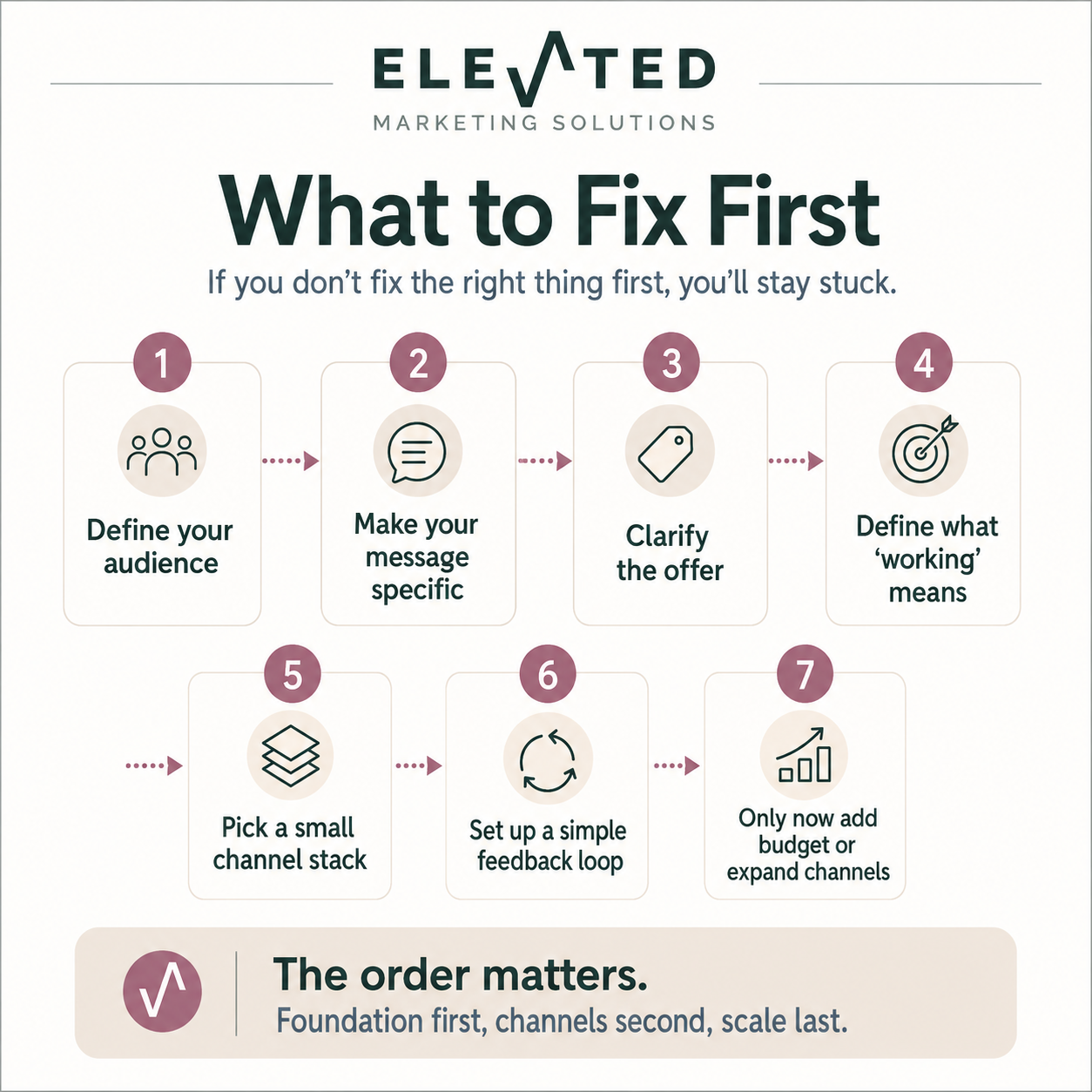 and repeatable across channels.