Clear Positioning: How to Stop Sounding Like Every Other Business

If your website, social media, ads, and sales conversations sound like every other business in your industry, the problem may not be that you aren’t doing enough marketing.
It might be your positioning.
Many businesses are actively marketing. They are posting on social media, updating their website frequently, running ads, sending email blasts, attending networking events, and trying to stay visible. But even with all of that activity, they still struggle to clearly explain why someone should choose them over another option.
That’s where positioning matters.
Strong positioning helps your business become easier to understand, easier to remember, and easier to choose. It gives your marketing a clearer direction because every message, campaign, and sales conversation is built around what makes your business relevant and valuable to the right customer.
What Does Positioning Mean in Marketing?
Positioning is the space your business occupies in the mind of your ideal customer compared to every other option they could choose. In simple terms, positioning answers the question: why should someone choose you? It is not just your tagline, your logo, or the list of services you provide. Positioning is the strategic foundation behind how people understand your business.
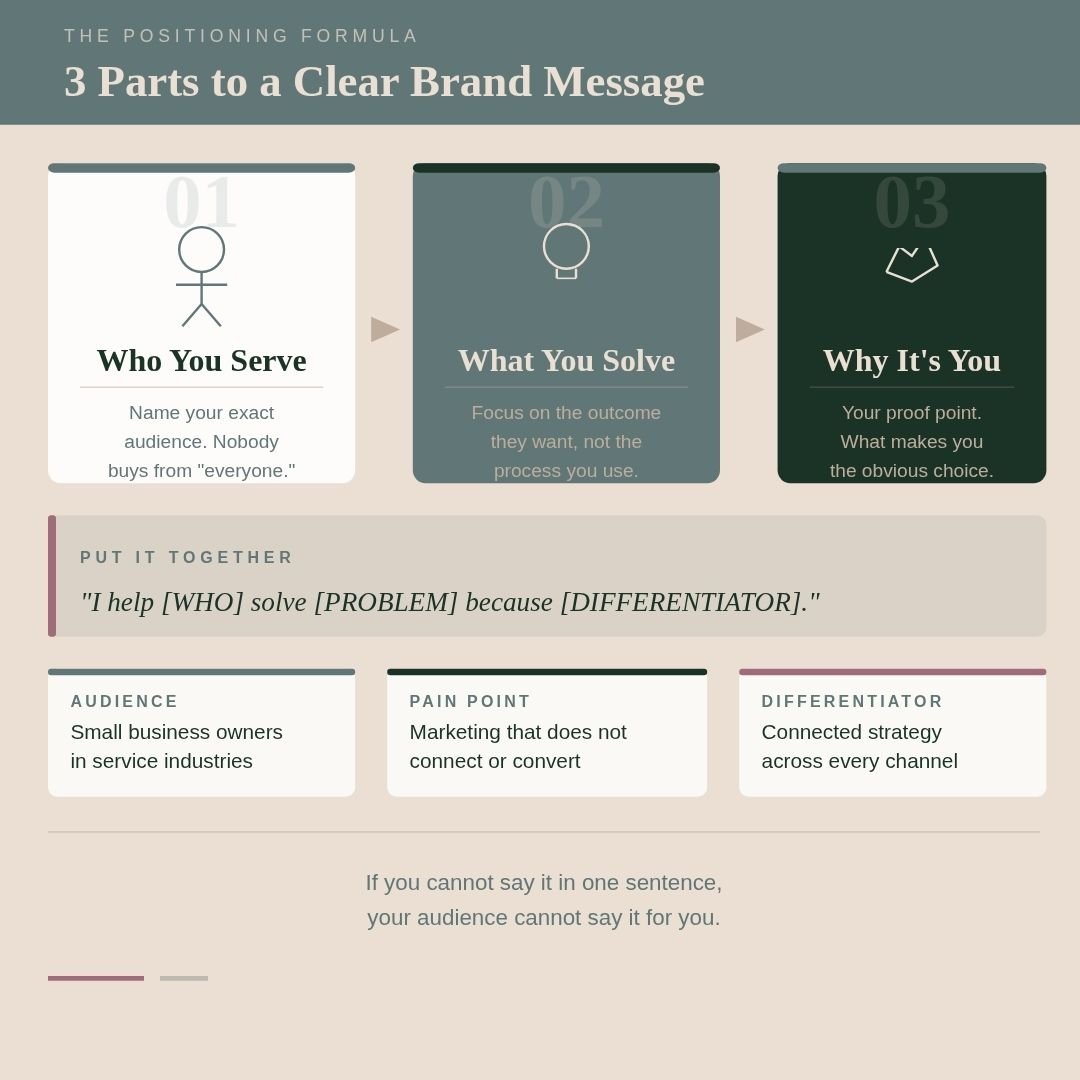
It defines who you serve, what problem you solve, why your approach matters, and what makes you the right fit. For example, saying, “We are a full-service marketing agency,” is very different from saying, “We help businesses connect their website, SEO, content, ads, social media, email, analytics, and sales process so they can understand what is working and where to improve.” The first statement simply describes a category. The second communicates a position and gives the buyer a clearer reason to care.
Strong Positioning Matters
When your positioning is unclear, your marketing usually becomes unclear too.
Your website may list services but fail to communicate value. Your social media may be active but scattered. Your ads may get clicks but they’re not converting. Your sales conversations may require too much explanation. Your prospects may understand what you do, but not why you are the right choice.
Strong positioning helps solve that.
When your business has clear positioning, your marketing becomes more focused. You know what message you are trying to reinforce. You understand which customers you are trying to attract. You can create content that speaks to real pain points instead of generic topics. You can build campaigns that support the same business goals instead of disconnected marketing tactics.
Strong positioning can help your business:
- Attract better-fit customers
- Communicate your value more clearly
- Stand out from competitors
- Reduce price-based comparison
- Create stronger website messaging
- Improve sales conversations
- Make referrals easier
- Build more consistent content
- Connect your marketing around one clear message
The stronger your positioning, the easier it becomes for someone to say:
“That sounds like exactly what I need.”
Signs Your Business May Have a Positioning Problem
A positioning problem is not always obvious. Many business owners assume they have a lead generation problem, a website problem, an advertising problem, or a social media problem.
Sometimes they do.
But often, the deeper issue is that the business is not clearly positioned in the market.
Here are a few signs your business may have a positioning problem.
1.) Your Marketing Sounds Like Everyone Else’s
If your website uses the same language as your competitors, it becomes harder for buyers to understand why they should choose you.
Phrases like “quality service,” “custom solutions,” “trusted experts,” “full-service,” and “we care about our customers” may be true, but they are also common. They do not create a strong enough reason for someone to remember you.
Strong positioning goes beyond broad claims. It makes your value specific.
Instead of saying you offer quality service, explain what quality means in your business.
Do you respond faster? Do you communicate more clearly? Do you simplify a complicated process? Do you specialize in a certain type of customer? Do you provide a more transparent experience? Do you connect services in a way competitors do not?
The more specific your message becomes, the easier it is for the right customer to see the difference.
2.) You Are Attracting the Wrong Leads
If you are getting inquiries but many of them are not the right fit, your positioning may be too broad.
A business can be visible and still attract the wrong people. This often happens when the marketing focuses only on services instead of clearly identifying who the business is best suited to help.
For example, a business may say:
“We provide landscaping services.”
But that could mean many things. Are they best for homeowners who want routine lawn maintenance? High-end outdoor living projects? Commercial property managers? Busy families who want low-maintenance landscaping? Neighborhoods with strict HOA standards?
Each audience has different needs, expectations, budgets, and decision-making factors.
Strong positioning helps your marketing speak more directly to the customers you actually want.
3.) People Do Not Understand What Makes You Different
A lot of businesses are better than their marketing makes them sound. They may have a better process, stronger experience, deeper knowledge, a more personal approach, better communication, or a more strategic way of solving problems, but if those differences are not clearly communicated, prospects may not see them.
That creates a problem because when buyers cannot identify a meaningful difference, they often compare based on price, convenience, or familiarity. Your positioning should make your difference clear enough that a prospect understands why your business is a better fit for their specific need.
That does not mean you have to be different in every way. It means you need to clearly communicate the difference that matters most to your ideal customer.
4.) Your Sales Conversations Require Too Much Explanation
If you constantly have to explain what you do, who you help, or why your approach matters, your positioning may not be doing enough work before the sales conversation.
Good positioning helps educate the buyer before they ever talk to you.
Your website, content, ads, emails, and social media should help prospects understand:
- What you do
- Who you help
- What problem you solve
- Why your approach is valuable
- What makes you different
- What kind of result or experience they can expect
When that foundation is clear, sales conversations can move faster and go deeper. Instead of spending the whole conversation explaining your value, you can focus on whether the prospect is the right fit and how you can help.
5.) Your Content Feels Scattered
If your content feels random, your positioning may not be clear enough. Businesses often create content because they know they need to stay visible, but without strong positioning, content can become a collection of disconnected posts, blogs, videos, and emails that do not reinforce a consistent message. Strong positioning gives your content strategy direction because it helps you know what topics to talk about, what problems to address, what questions to answer, what proof to share, and what message to repeat.
For example, if your business is positioned around simplifying a complicated process, your content should educate, clarify, and reduce confusion. If your business is positioned around premium expertise, your content should demonstrate depth, quality, and trust. If your business is positioned around speed and convenience, your content should reinforce ease, responsiveness, and reduced friction. Your content should not just keep you visible. It should strengthen the position you want to own.
Why Businesses Struggle With Positioning
Many businesses struggle with positioning because they are too close to what they do.
They know their services. They know their team. They know their process. They know the details of the work. But they may not see the business the way a customer sees it.
That is why businesses often default to describing what they offer instead of explaining why it matters.
Common positioning challenges include:
- Trying to appeal to everyone
- Describing services instead of solving problems
- Copying competitor language
- Using broad claims that are hard to prove
- Not knowing what customers value most
- Letting the business evolve without updating the messaging
- Confusing branding, messaging, and positioning
- Focusing too much on what the company does and not enough on what the customer needs
A business may have a strong value proposition, but if that value is not clearly communicated, the market may not recognize it.
How to Create Stronger Positioning
 Strong positioning is not created by guessing at a better headline.
It requires looking at the business, the customer, the competition, and the market opportunity.
Here are some of the steps that help create stronger positioning.
1. Understand Your Current Position
Before you can improve your positioning, you need to understand how your business is currently showing up.
Look at your website, social media, ads, Google Business Profile, sales materials, email marketing, proposals, and customer reviews.
Ask:
- What do we currently claim to be?
- Is our message clear?
- Could a prospect quickly understand who we help?
- Do we sound different from competitors?
- Are we explaining our value or just listing services?
- Are we attracting the kind of customers we want?
- What would someone remember after visiting our website?
This step helps identify whether your current marketing is reinforcing a clear position or creating confusion.
2. Identify Your Best-Fit Customer
Strong positioning is built around the right audience.
That does not always mean you only serve one type of customer. But your marketing should be clear about who you are especially well-equipped to help.
Ask:
- Who are our best customers?
- Who gets the most value from our work?
- Who do we want more of?
- Who is the most profitable?
- Who is easiest to help?
- Who values our approach?
- Who is not a good fit?
The more clearly you understand your best-fit customer, the easier it becomes to create messaging that speaks directly to their needs.
3. Understand the Real Problem You Solve
Customers do not just buy services. They buy solutions to problems.
A business may think it sells a website, lawn care, dental services, accounting, legal support, or marketing. But the customer is often looking for something deeper.
They may want clarity. Confidence. Trust. Convenience. Relief. Growth. Better decisions. Less stress. More time. A better experience.
To strengthen your positioning, ask:
- What problem do customers think they have?
- What problem do they actually have?
- What are they frustrated by?
- What are they worried about?
- What have they already tried?
- What happens if they do nothing?
- What outcome are they really hoping for?
The strongest positioning often comes from understanding the deeper problem behind the service.
4. Study the Competitive Landscape
Positioning is not created in isolation. Your business is always being compared to other options.
Those options may include direct competitors, an in-house solution, a freelancer, a cheaper provider, software, or doing nothing.
Review your competitors and look for patterns.
Ask:
- What is everyone else saying?
- What claims are overused?
- What does every business in the category seem to promise?
- Where do competitors sound the same?
- What do customers complain about in reviews?
- What are competitors not explaining well?
- Where is there a gap in the market?
- What do we do differently that buyers would actually care about?
The goal is not to be different just for the sake of being different. The goal is to identify a meaningful difference that matters to your ideal customer.
5. Find Your True Differentiator
A true differentiator is not just something your business does well. It is something that is true, relevant, specific, and provable.
A strong differentiator may come from:
- Who you serve
- How you work
- What you understand better
- How you communicate
- Your process
- Your customer experience
- Your speed
- Your transparency
- Your specialization
- Your local knowledge
- Your technology
- Your philosophy
- Your ability to connect multiple parts of a solution
For example, “we care about our customers” is not strong enough on its own.
But this is stronger:
“We explain every step clearly so customers understand what is happening, what it means, and what to expect next.”
That is more specific. It speaks to a real customer need. It can be supported with proof.
6. Build Proof Around Your Position
A positioning claim needs evidence.
If you say you are strategic, show your process.
If you say you are transparent, show how you communicate.
If you say you simplify a complicated process, create content that explains confusing topics clearly.
If you say you deliver results, share examples, data, testimonials, or stories.
Proof can include:
- Case studies
- Testimonials
- Reviews
- Before-and-after examples
- Process explanations
- Data
- Client stories
- Screenshots
- Educational content
- Team expertise
- Industry experience
- Community reputation
The more proof you can provide, the more believable your positioning becomes.
7. Apply the Position Across Your Marketing
Positioning should not live only in one headline.
Once your position is clear, it should influence your entire marketing strategy.
That includes:
- Website copy
- Service pages
- SEO strategy
- Blog topics
- Social media content
- Paid ads
- Email marketing
- Sales materials
- Proposals
- Videos
- Google Business Profile
- Referral conversations
- Reporting
This is where many businesses fall short. They may have a strong message in one place, but the rest of their marketing does not support it. When your marketing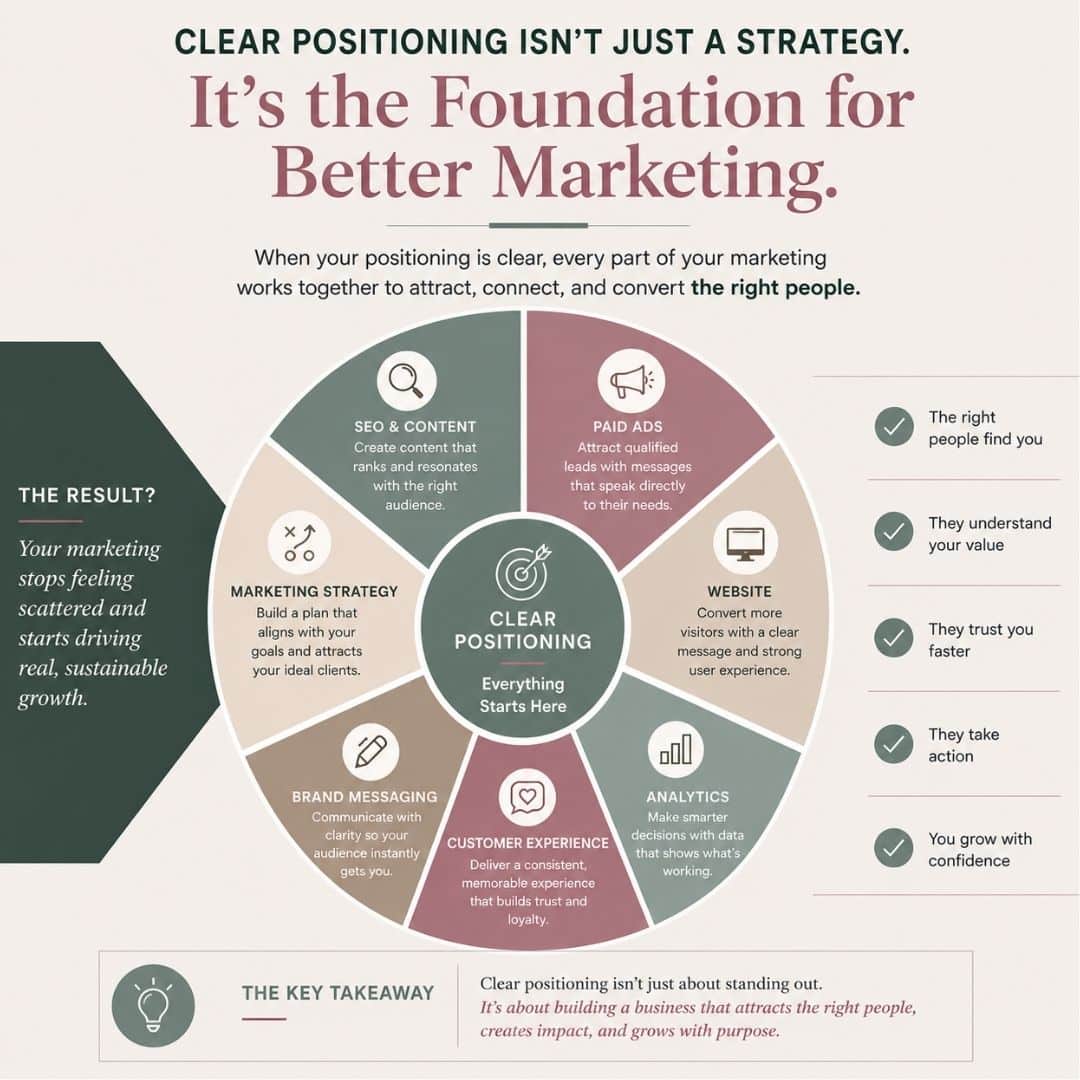 channels are disconnected, your positioning becomes diluted. Your website may communicate one message, while your ads promote something different, your social media focuses on another idea, and your sales materials use different language altogether. Strong positioning needs consistency.
Every part of your marketing should work together to reinforce what you want your business to be known for, so your audience receives a clear and consistent message no matter where they interact with your brand.
Positioning and Marketing Strategy Work Together
Positioning is not separate from your marketing strategy; it should guide it. Your positioning affects what pages your website needs, what keywords matter, what content you create, what ads you run, what testimonials you highlight, what emails you send, and how your sales team talks about the business. Without clear positioning, marketing can become a collection of disconnected tactics. With clear positioning, every part of your marketing has a stronger purpose.
Your website explains your value, your content reinforces your expertise, your ads speak to the right audience, your social media builds trust, your email marketing supports the buyer journey, and your reporting helps you understand what is working and where to improve. That is when marketing becomes more than activity. It becomes direction.
A Strong Position Makes Your Business Easier to Choose
Most businesses do not need more generic marketing; they need clearer marketing. They need to understand what they want to be known for, who they are trying to attract, what problem they solve, and why their approach matters. Strong positioning helps make that possible by giving your business a clearer place in the market and giving your customers a clearer reason to choose you.
When your positioning is strong, your marketing does not have to work as hard to explain who you are because it reinforces what already makes your business valuable. If your marketing feels scattered, your leads are not the right fit, or your message sounds too similar to your competitors, it may be time to take a closer look at your positioning.
At Elevated Marketing Solutions, we help businesses connect every part of their marketing strategy so their website, SEO, content, ads, social media, email, analytics, and sales process work together with purpose. Because stronger marketing does not start with doing more. It starts with knowing what you want to be known for.