Your Brand Name Is Not Just a Name Anymore: Why Consistency Matters for Search, AI, and Trust
For years, businesses have used shortened versions of their name without giving it much thought.
Maybe the full company name is used on the website, but employees shorten it in emails. Maybe the legal name appears on invoices while the public-facing brand name appears on social media. Maybe an old proposal template still uses a previous version. Maybe your Facebook page was created years ago under a slightly different spelling. Maybe your social media handle is abbreviated because the full name was unavailable.
Most people can make sense of that.
A customer may understand that “ABC Financial Group,” “ABC Financial,” “ABCF,” and “ABC Wealth” are all connected. They can use context, memory, logos, conversation, and common sense to figure out what they are looking at.
But search engines, directories, maps, knowledge systems, and AI tools do not interpret information in quite the same way.
They have to make connections based on the signals they can find.
When your business name appears in multiple forms across your website, social media profiles, directories, reviews, old documents, press mentions, team bios, and partner websites, those systems have to determine whether each reference belongs to the same organization.
The more inconsistency they find, the more ambiguity they have to work through.
That does not mean one missing comma or one shortened social handle will suddenly damage your business. It means that repeated inconsistency can make it harder for technology, and sometimes customers, to confidently understand who you are, what you do, and which information belongs to your brand.
As search becomes more connected to AI-generated answers, local listings, online reviews, social profiles, third-party mentions, and knowledge-based results, using your name consistently is becoming more important than ever.
Humans Can Recognize Variations. Systems Have to Connect the Dots.
A human may see “Elevated Marketing Solutions” on a website, “Elevated Marketing” in a Facebook post, “EMS” in an internal presentation, and 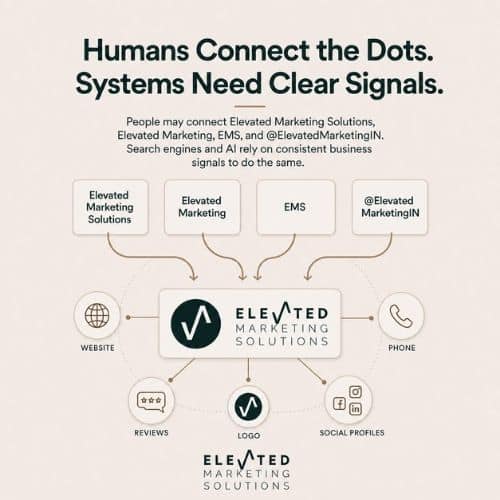 “ElevatedMarketingIN” as a social media handle and understand that all four refer to the same business.
A search engine or AI system may be able to make that connection too, but it has to rely on surrounding information to do it.
It may look at:
- The business name
- Website URL
- Logo
- Phone number
- Address or service area
- Business category
- Description of services
- Leadership names
- Social profile links
- Reviews
- Mentions on third-party websites
- Structured business information
- Historical references to the brand
When those details consistently reinforce one another, it becomes easier to understand that the information represents one real business.
When those details conflict, the picture becomes less clear.
For example, a shortened name by itself may not be a major issue. But when that shortened name is paired with an old logo, an outdated phone number, a different address, an old website URL, and a vague business description, the system has more reason to question whether it is looking at the same company.
That is the real concern.
It is not just capitalization. It is not just punctuation. It is not even just the name itself.
It is identity drift.
What Is Identity Drift?
Identity drift happens when your business slowly starts showing up in different ways across different places.
It may look like this:
- Your website uses one version of the name.
- Your Google Business Profile uses another.
- Your legal name appears on invoices.
- Your social accounts use abbreviations.
- Your old logo is still attached to a directory listing.
- A former business name still appears on a chamber website.
- Employees use different versions in LinkedIn bios.
- A partner lists your company under a nickname.
- A job posting uses a parent-company name that customers never see.
- A podcast description links to an outdated website.
Each one may seem small on its own.
Together, they can create a scattered picture of your business.
This can affect more than search visibility. It can affect customer trust, referral accuracy, local discovery, review management, sales consistency, reporting, and the ability for people to recognize your brand across the places where they encounter it.
Your Brand Name, Legal Name, DBA, Parent Company, Product Name, and Acronym Are Not Always the Same Thing
One reason businesses struggle with consistency is that they are often managing several legitimate names at once.
That is normal.
Your business may have:
- A public-facing brand name that customers know
- A legal business name used for contracts, taxes, banking, and registration
- A DBA, or “doing business as,” name
- A parent company name
- A division or subsidiary name
- A product or service-line name
- A former business name
- An acronym or common abbreviation
- A social media handle that is shorter than the full brand name
The issue is not that these names exist.
The issue is when your team has never decided how each one should be used.
For example, a business may legally operate as “Elevated Marketing, LLC” but market itself as “Elevated Marketing Solutions.” It may use “EMS” internally. It may have a division called “Elevated Marketing.” It may have acquired another company that still has brand recognition in the local market.
Without clear standards, those names can start appearing interchangeably in public-facing places.
That can create confusion for customers and make it harder for search engines and AI systems to understand how the names are connected.
Every business should define:
- Its primary public-facing brand name
This is the name customers should see most often across your website, social profiles, marketing materials, proposals, ads, events, and communications. - Its legal business name
This may be required on contracts, invoices, tax documents, or legal pages, but it should not automatically replace the public-facing brand name everywhere else. - Its approved alternate names
These may include a common acronym, shortened name, former name, DBA, division name, or well-known nickname. - Its unapproved variations
These may include misspellings, outdated names, inconsistent punctuation, unclear abbreviations, or versions that make the brand harder to recognize.
Once those standards are defined, your team can use each name intentionally instead of randomly.
Aliases Are Not Always a Problem. Unmanaged Aliases Are.
Many businesses have aliases, former names, abbreviations, or alternate descriptions that are still important.
A company may have been known by a previous name for 20 years. A local audience may commonly use an acronym. A division may have its own identity. A parent company may need to be referenced in some situations. A rebrand may have changed the public-facing name while preserving the legal company structure.
Trying to erase every old reference is not always realistic or even helpful.
The better approach is to clearly connect those names to the current brand.
For example:
- “Smith & Johnson Financial Group, formerly known as S&J Financial”
- “BrightPath Home Services, a division of BrightPath Holdings”
- “Greenline Roofing, doing business as Greenline Exteriors”
- “ABC Manufacturing, also known locally as ABCM”
- “Northside Medical Partners, part of the Northside Health Network”
The key is not simply to mention every possible name everywhere.
The key is to create a clear relationship between them.
Your website is usually the best place to establish that relationship. Depending on your situation, that may include:
- A sentence on your About page explaining a former name
- A short note on your contact page
- A rebrand announcement or FAQ
- A page explaining your parent company or divisions
- Clear descriptions on social media profiles
- Updated directory listings
- Consistent company descriptions in media kits and partner bios
- Redirects from former domains to your current website
- A statement in legacy social bios directing visitors to the current brand
For example:
Formerly known as ABC Financial, ABC Wealth Advisors is the same locally owned team, now operating under a name that better reflects the full range of planning and advisory services we provide.
That language gives customers context. It also helps connect the historical name to the current brand instead of leaving them looking like separate companies.
Social Media Handles Matter, But They Are Not the Whole Story
Many businesses worry because their exact company name is not available as a social media handle.
That is understandable, but it is not automatically a major problem.
You may need to use an underscore, a shortened version, a location identifier, or an abbreviated handle. For example:
@ABCFinancial@ABCFingroup@ABCFinancialIN@TheABCGroup@ABCWealthTeam
The handle itself does not need to do all the work.
What matters is whether the profile clearly identifies the business.
Your social profiles should reinforce your official brand by including:
- The full public-facing business name as the display name whenever possible
- Your approved logo
- A clear description of what you do
- A link to the correct website
- Current location or service-area information
- Updated contact information
- Consistent service descriptions
- Language that clarifies any abbreviation or alternate name
For example, a profile may use the handle @ElevatedMarketingIN, but the display name should still say “Elevated Marketing Solutions.” The bio should explain what the company does, who it serves, and where it operates. The website link should point to the official domain.
A shortened handle is manageable.
A shortened handle paired with an unclear display name, outdated logo, old website, conflicting contact information, and vague business description creates a much bigger issue.
Context Matters: Your Name Needs to Be Connected to What You Do
It is not enough for the internet to see your business name.
Your name needs to be consistently connected to the information that explains what your business actually is.
That includes:
- Your services
- Your industry or category
- Your location or service area
- Your leadership team
- Your specialties
- Your customer type
- Your differentiators
- Your website
- Your official social profiles
- Your reviews and third-party mentions
For example, a business name alone does not tell anyone much.
But when a business name repeatedly appears alongside the same service category, location, leadership, and positioning, it becomes much easier to understand.
Instead of simply saying:
We help businesses grow.
A more useful business description might say:
Elevated Marketing Solutions is a full-service marketing agency that helps businesses connect strategy, content, SEO, social media, paid advertising, websites, reporting, and customer experience into a more complete growth plan.
That description connects the name to the company’s category, value, and expertise.
This becomes even more important as a business grows.
What Happens When Your Business Expands?
Business identity can become more complicated when you:
- Open a second location
- Enter a new market
- Add a new service line
- Launch a product brand
- Acquire another business
- Merge with another company
- Add a franchise location
- Create a parent company structure
- Change ownership
- Shift from serving one audience to serving several
- Expand from local to regional or national service
These changes can be exciting, but they can also create confusion if the branding structure is not clear.
For example, if a local company launches a commercial division, should that division have its own website? Its own social accounts? Its own Google Business Profile? Its own logo? Or should it operate as a clear part of the original brand?
There is not one universal answer.
The right answer depends on the audience, customer journey, business model, location structure, product offerings, and long-term growth plan.
But the question should be answered intentionally before new profiles, domains, logos, or business names begin appearing publicly.
When a business expands, it should define:
- What remains under the main brand
- What needs its own identity
- How each division connects to the parent or primary brand
- Whether customers should see separate brands or one unified brand
- Which names belong on contracts, invoices, proposals, and public materials
- Whether separate websites, profiles, or locations are truly needed
- How reviews, directories, and social accounts will be managed
- How the business will avoid creating duplicate or competing identities online
A brand architecture decision may feel like an internal branding conversation, but it has real implications for SEO, local visibility, customer trust, content planning, paid advertising, analytics, and referrals.
A Rebrand Is Not Just a Creative Decision
A rebrand can be exciting.
It may reflect a new direction, expanded services, stronger positioning, new ownership, a merger, or a better understanding of who the business has become.
But a rebrand is not just a logo change.
It is an identity-management decision.
Changing your business name can affect:
- Existing branded search demand
- Customer recognition
- Online reviews
- Directory listings
- Google Business Profile information
- Maps and navigation platforms
- Social media handles
- Website URLs
- Email addresses
- Employee signatures
- Backlinks from other websites
- Press coverage
- Referral partners
- Sales collateral
- Proposal templates
- Contracts and invoices
- Advertising accounts
- Analytics and tracking systems
- Internal documents
- Customer trust during the transition
Before a rebrand, businesses should ask:
- Are we changing the name because the current brand is truly limiting growth, or because we are tired of it?
- Do customers already recognize and trust the existing name?
- Does the new name make the business clearer, stronger, or more differentiated?
- Will the new name create confusion with another company?
- Do we have the budget and internal capacity to update every important touchpoint?
- How will we explain the transition to customers, employees, partners, and referral sources?
- What will happen to our old website domain, social handles, reviews, and directory listings?
- How long should we reference the former name?
- Will the rebrand solve a real business problem, or simply create more work?
A strong rebrand plan should include more than creative development. It should include:
- A complete brand-name audit
- Domain and redirect planning
- Social handle planning
- Google Business Profile updates
- Directory cleanup
- Updated website messaging
- Customer communication
- Employee training
- Partner and vendor communication
- Updated proposals, sales materials, invoices, and contracts
- Tracking and analytics review
- Review-platform updates
- A plan for preserving the value of the old name while building recognition for the new one
The goal is not to make the old name disappear overnight.
The goal is to help customers and systems understand the transition clearly.
Internal Inconsistency Becomes External Inconsistency
One of the most overlooked sources of brand confusion is internal communication.
Your employees may be using a shorthand name because it is faster. Your sales team may still have an old proposal template. Your accounting system may use the legal business name. A manager may create a sponsorship listing without checking brand standards. A team member may create a social account, directory profile, or event page using a version of the name that feels close enough.
Over time, those internal shortcuts become public signals.
They may show up in:
- Email signatures
- Sales decks
- Proposal templates
- Invoices
- Job postings
- Team-member bios
- Online applications
- Partner websites
- Event sponsorships
- Community listings
- Press releases
- Podcast bios
- Webinar pages
- Downloadable documents
- Vendor portals
- Recruiting platforms
- Conference materials
That is why brand-name consistency cannot live only with the marketing department.
It needs to be part of your internal process.
Employees who communicate externally should know:
- The official public-facing brand name
- When to use the legal business name
- Approved abbreviations and alternate names
- Which logo files are approved
- Which company description should be used
- Which website URL is official
- Which social links are current
- Who is responsible for approving new public profiles or listings
- What to do when they find an outdated reference online
The easier you make these standards to find and use, the more likely your team is to follow them.
This Belongs in Your Brand Guidelines
Brand guidelines often focus on colors, fonts, logos, imagery, and tone of voice.
Those pieces matter.
But modern brand guidelines should also include identity standards.
Your guidelines should answer questions such as:
- What is the official public-facing company name?
- How should the name appear in writing?
- Are punctuation and capitalization part of the approved name?
- Which abbreviations are approved?
- Which abbreviations should not be used?
- What is the legal company name?
- When should the legal name appear?
- Is there a DBA or parent company relationship that needs to be explained?
- How should former names be referenced?
- Which logo versions are approved?
- What business description should employees and partners use?
- Which domains, email formats, and social handles are official?
- Who owns the approval process for new public-facing profiles?
- How often should business listings and public references be reviewed?
This is not about making the team overly cautious or rigid.
It is about preventing avoidable confusion.
A clear standard helps everyone, from a new employee to a long-time sales representative to an outside partner, represent the business accurately.
How to Audit Your Business Name Online
A name-consistency audit should go well beyond major social platforms.
Start by searching for your business name, former business names, acronyms, common misspellings, old phone numbers, old addresses, and previous website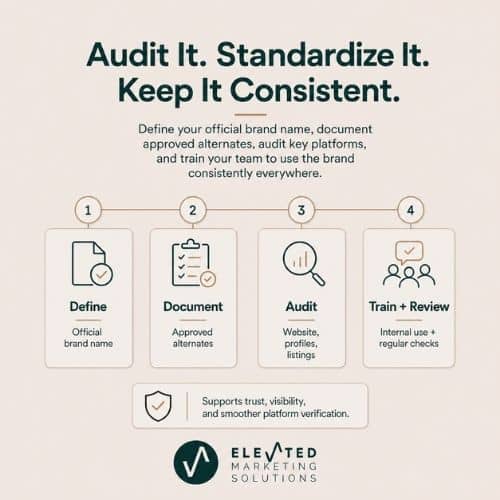 domains.
Then review the places where your business appears.
That may include:
- Your website
- Old website pages
- Google Business Profile
- Bing Places
- Apple Maps
- YouTube
- X
- TikTok
- Industry directories
- Local directories
- Chamber of commerce listings
- Professional associations
- Review platforms
- Better Business Bureau profiles
- Partner websites
- Vendor and supplier listings
- Event pages
- Sponsorship pages
- Podcast show notes
- YouTube descriptions
- Press mentions
- Job boards
- Employee LinkedIn profiles
- Author bios
- Downloadable PDFs
- Online presentations
- Public proposal documents
- Online advertising accounts
- CRM templates
- Email signatures
- Review-request templates
- Referral-partner materials
As you review each item, look beyond the business name alone.
Check whether the following are accurate and consistent:
- Business name
- Website URL
- Phone number
- Address or service area
- Email address
- Logo
- Business description
- Service categories
- Leadership names
- Social media links
- Hours
- Review links
- Brand imagery
- Former-name references
- Parent-company or division information
Prioritize the places that matter most to customers, search visibility, and trust:
- Your website
- Google Business Profile
- Major social platforms
- Maps and local listings
- High-authority directories
- Review platforms
- Partner and referral websites
- Recent press and event pages
- High-traffic legacy profiles
Then create a process for reviewing those places regularly.
Inconsistent Names Can Create Problems Beyond Search
Brand-name consistency can also affect more practical parts of your marketing operations.
Platforms such as Google Ads may ask businesses to verify advertiser information, business details, domains, or legal entities. A small difference in naming will not automatically cause an account issue, but when your legal business name, website, payment profile, advertiser information, and public-facing brand do not clearly connect, it can create delays, rejected assets, verification questions, or more complicated account reviews.
The same is true for reviews, billing, sales materials, customer communications, and referral relationships. A clear business identity makes it easier for people and platforms to understand who they are dealing with.
What to Do When You Find Inconsistencies
Do not start changing everything without first deciding what the correct version should be.
Begin by creating one source-of-truth document for your company identity.
That document should include:
Your Primary Brand Name
The exact name that should appear in customer-facing marketing, website copy, social profiles, proposals, advertisements, and most communications.
Your Legal Name
The version required for contracts, tax documentation, regulatory filings, banking, and other legal uses.
Approved Alternate Names
Any acronym, short version, DBA, former name, parent-company relationship, or division name that may be used, and where it should appear.
Unapproved Variations
Common misspellings, outdated names, inconsistent abbreviations, or formats your team should avoid.
Approved Business Descriptions
A short version for bios and listings, a medium version for directories and partnerships, and a longer version for website pages or press materials.
Official Contact Details
The correct website URL, email format, phone number, physical address, service area, and social links.
Approved Logo Files
The current versions of your logo, including guidance on which file should be used in which format.
Ownership and Approval Process
Who is responsible for updating listings, approving new profiles, managing rebrand transitions, and reviewing recurring audits.
Once that source of truth is in place, you can work through the audit with purpose instead of guessing.
Consistency Helps More Than SEO
This conversation is often framed as an SEO issue.
It is bigger than that.
Using your name consistently supports:
Customer Trust
When people see the same name, website, logo, services, and contact information across several places, the company feels more established and dependable.
When they see multiple versions of the name, old websites, mismatched branding, or conflicting information, uncertainty can set in.
Better Referrals
Customers, employees, partners, and community contacts are more likely to refer people accurately when they know exactly what to call your business and where to send people.
Sales Alignment
Your proposals, follow-up emails, presentations, onboarding documents, and service materials reinforce one clear identity.
More Reliable Reporting
It becomes easier to monitor branded searches, reviews, referral traffic, online mentions, and local visibility when your company is represented consistently.
Stronger Long-Term Visibility
The more clearly your business is connected across its website, listings, reviews, content, social media, partnerships, and press mentions, the easier it is for people and technology to understand that those signals belong to the same organization.
The Goal Is to Make Your Business Easy to Understand
Your business should not require guesswork.
A customer should be able to see your company in a search result, social profile, review, podcast description, event page, directory listing, or AI-generated answer and immediately understand:
- Who you are
- What you do
- Where you serve
- How to contact you
- Whether the information is current
- Whether each reference belongs to the same business
That is the real value of name consistency.
It is not about obsessing over every minor formatting choice.
It is about reducing confusion, protecting the recognition you have built, strengthening trust, and making it easier for people and technology to connect every part of your business identity.
As search, AI, local discovery, reviews, content, and third-party mentions become more connected, your business name becomes more than a label.
It becomes one of the clearest signals that everything people see about your company belongs together.
Watch now