Marketing Campaigns vs. Continuous Marketing: Stop Picking Sides
Don’t choose one learn how balancing short-term sprints and long-term strategy is the key to scalable, sustainable growth.

A lot of business owners ask the same marketing questions, but they are not always asking the same type of question. Sometimes they are asking about a campaign, and sometimes they are asking about continuous marketing. The problem is that those two needs often get mixed together, which can make the marketing plan feel scattered before it ever starts.
When a business owner asks, “Should we run a promotion?” or “How do we get more registrations for this event?” or “How do we push this seasonal service right now?” they are usually asking a campaign question. A campaign is useful when there is a specific offer, event, launch, season, or short-term goal that needs focused attention.
When a business owner asks, “Should we focus on SEO?” or “Do we need to post more consistently?” or “How do we stay in front of people when they are not ready to buy yet?” they are usually asking a continuous marketing question. Continuous marketing is useful when the goal is to build visibility, trust, search presence, brand recognition, and long-term lead flow over time.
Both questions matter. A business needs marketing that can help generate action now, but it also needs marketing that builds the foundation for future growth. That is where the difference between campaign-based marketing and continuous marketing becomes important.
Think of Campaigns as Fireworks and Continuous Marketing as a Campfire
A helpful way to understand the difference is to think about fireworks and a campfire. Campaigns are like fireworks. They are bright, attention-grabbing, time- 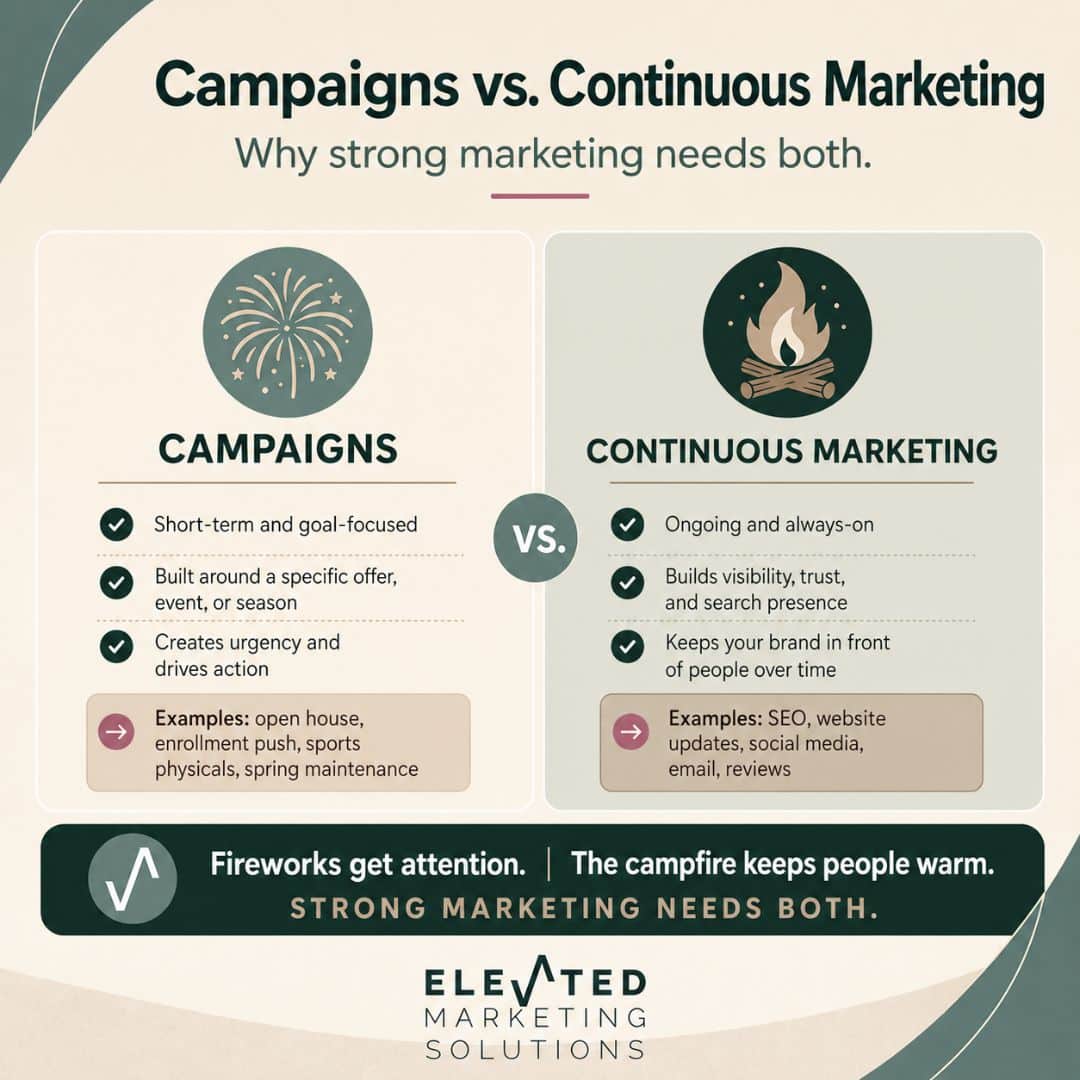 sensitive, and designed to make people look in a specific direction at a specific moment. They work well when you need to promote an event, launch an offer, fill a seasonal need, or give your audience a reason to act now. Continuous marketing is more like a campfire. It is steady, consistent, and built to keep people close over time. It creates warmth around your brand through helpful content, SEO, social media, email, reviews, website updates, customer experience, and ongoing trust-building. Fireworks can get attention, but a campfire gives people a reason to stay. Strong marketing needs both because attention alone fades quickly, and consistency without clear moments of action can lose momentum.
Campaigns are focused, time-sensitive pushes designed to create momentum around a specific goal. Continuous marketing is the ongoing work that keeps your business visible, trusted, and understood even when you are not actively promoting a specific offer. One is not better than the other. They serve different purposes, and the strongest marketing strategies use both.
The problem happens when businesses rely too heavily on one and neglect the other. If you only run campaigns, your marketing becomes reactive. If you only focus on continuous marketing without clear moments of action, your audience may stay aware of you but never feel a reason to move forward.
At Elevated Marketing Solutions, we think about this through the lens of Data Over Time. Real growth rarely comes from one post, one ad, one email, or one campaign. It comes from understanding how every piece of marketing supports visibility, trust, lead generation, sales, retention, and long-term business growth.
The Real Problem: Most Businesses Swing Between Silence and Selling
Many businesses do not have a campaign problem or a content problem. They have a consistency and connection problem. They are either quiet until they need leads, or they are constantly creating content without a clear plan for where it is leading.
You may recognize some of these patterns. A business only markets when sales slow down. It runs a promotion, but the audience has not heard from the brand in months. It posts on social media consistently, but there is no clear call to action. It invests in ads, but the website does not explain the value clearly. It sends emails only when it wants people to buy something. It creates blogs, videos, or social posts, but they are not tied to services, offers, or sales goals.
This is where marketing starts to feel scattered. Campaigns can create urgency, but they need an audience that already understands and trusts the brand. Continuous marketing builds that familiarity and trust, but it still needs focused moments that move people to act. The goal is not to choose one. The goal is to build a marketing system where both work together.
Where Campaigns and Continuous Marketing Fit in the Buyer Journey
Your audience does not usually go from hearing about you once to immediately becoming a customer. They move through a journey. They may notice your brand, compare options, look for proof, ask questions, check reviews, visit your website, talk to someone they trust, and come back later when the timing is right.
Campaigns and continuous marketing support different parts of that journey.
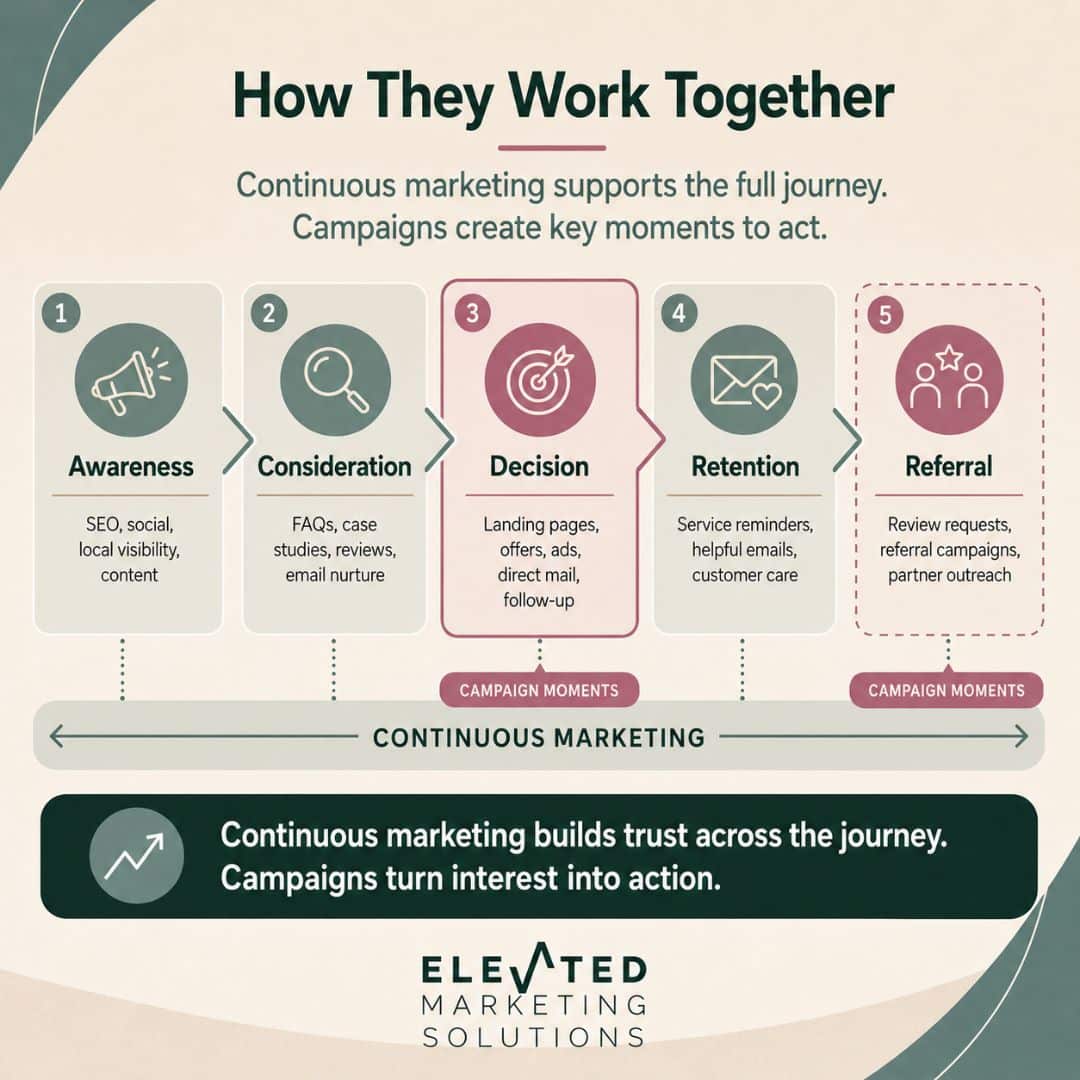
Awareness – Continuous Marketing
At the awareness stage, people are just becoming familiar with your business or realizing they have a problem you can solve. This is where continuous marketing matters most because your audience may not be ready to take action yet. They may find you through search, social media, a referral, an event, a podcast, a community post, a review, or a Google Business Profile listing.
Marketing support at this stage may include educational blog posts, SEO-focused service pages, short-form video, social media content, local PR, community involvement, Google Business Profile updates, helpful website content, brand storytelling, and review visibility. The goal is not always immediate conversion. The goal is to become familiar, credible, and relevant.
Consideration – Continuous and Campaign Marketing
At the consideration stage, your audience is evaluating whether you are the right fit. They are asking whether your business can solve their problem, whether you understand what they need, whether you have experience, whether you are trustworthy, how you are different, what the process looks like, and what the investment may be.
This is where continuous marketing continues to do important work. Your website, blogs, FAQs, case studies, testimonials, emails, videos, and sales materials help people understand your value before they reach out. Marketing support at this stage may include comparison content, FAQs, case studies, testimonials, service-specific blogs, process explanations, email nurture, retargeting ads, website trust signals, and educational videos.
The goal is to reduce confusion and build confidence so the person feels more prepared to take the next step.
Decision – Campaign Marketing
At the decision stage, your audience is closer to taking action. This is where campaigns become especially useful because a campaign can give people a timely reason to book, call, register, schedule, request a quote, attend an event, or start a conversation. The marketing at this stage should do two things at once: reach new people who may be a good fit and move already-engaged people toward a clear next step.
Landing pages support a campaign by giving the audience one focused place to go after seeing an ad, email, social post, direct mail piece, or event promotion. Instead of sending people to a general homepage, a landing page can speak directly to the campaign message, explain the offer, answer common questions, show proof, and make the call to action clear. For example, a healthcare practice promoting sports physicals could use a landing page that explains who needs one, what to bring, how long the appointment takes, available locations, and how to schedule. That page can serve both new visitors coming from ads or search and warmer audiences who came from email or social media.
Limited-time offers support a campaign by giving people a reason to act sooner rather than later. This does not always have to mean a discount. It could be a limited number of consultation spots, an early registration deadline, priority scheduling, a seasonal package, or a bonus resource for people who inquire by a certain date. For a B2B service company, this might look like offering a limited number of assessments during a specific month. The offer gives new audiences a clear reason to pay attention and gives familiar audiences a reason to stop waiting.
Event promotions support a campaign by building attention before, during, and after an event. The campaign may include social posts, email reminders, website updates, partner promotion, paid ads, signage, and follow-up communication. For an education-based organization, an open house campaign might include a landing page for registration, social media posts highlighting program benefits, emails to past inquiries, reminder texts, and a follow-up email after the event. To reach new people, the organization could also use paid social ads, community partnerships, local PR, school or employer partnerships, and shared promotion from partners who already have access to the right audience.
Seasonal campaigns support a campaign by aligning the message with a time of year when the audience is already thinking about the need. A local service business may promote spring maintenance, winter preparation, storm response, or back-to-school readiness depending on the service. The season gives the campaign natural relevance, while the marketing helps the audience connect that timing to a clear next step. These campaigns can reach new people through local SEO, Google Ads, neighborhood direct mail, social media ads, community groups, and referral partners, while also reminding past customers and existing contacts to take action.
Consultation campaigns support a campaign by creating a softer entry point for people who are interested but not ready to fully commit. This can work especially well for service-based businesses, healthcare practices, professional services, and B2B companies where the buying decision requires trust. A consultation campaign may invite people to schedule a discovery call, request an assessment, talk with an expert, or review their current situation before making a decision. To reach new people, the campaign may use search ads for high-intent keywords, LinkedIn outreach or ads for a defined professional audience, referral partner promotion, educational content, or a downloadable resource that introduces the business before asking for a deeper commitment.
Email promotions support a campaign by reaching people who already have some level of familiarity with the business. These may include past customers, current customers, old leads, event attendees, referral partners, or people who downloaded a resource. Email can explain the campaign, remind people of deadlines, answer objections, share proof, and create multiple touchpoints without relying only on social media or ads. While email is usually stronger for nurturing existing audiences, it can also help reach new people when subscribers forward the email, referral partners share it with their networks, or the campaign includes a lead-generation offer that brings new contacts into the list.
Paid ads support a campaign by helping the business reach people beyond its current audience. Search ads can capture people already looking for a service, solution, event, or provider. Social ads can introduce the campaign to people who match the right geography, interests, behaviors, job titles, life stage, or customer profile. LinkedIn ads can help B2B companies reach a specific industry, role, or company type. Paid ads are often most effective when they are not working alone, but instead drive people to a clear landing page, align with the campaign message, and are supported by follow-up.
 Retargeting ads support a campaign by staying in front of people who showed interest but did not take action. If someone visited the landing page, watched a video, clicked an email, or engaged with social content, retargeting can remind them of the offer and bring them back. Retargeting is not usually the first touchpoint for new audiences, but it is important because many new people will not convert the first time they discover the business. Retargeting helps turn that first moment of awareness into another opportunity to act.
Direct mail supports a campaign by creating a physical touchpoint, especially for local businesses, healthcare organizations, education-based organizations, restaurants, events, and service providers. A postcard, invitation, magnet, or printed offer can reinforce the same message people are seeing online. Direct mail is also a strong way to reach new people in a specific geography, neighborhood, household type, or service area. For example, a local service business could use direct mail to promote a seasonal maintenance campaign in specific neighborhoods while also running Google Ads and posting related educational content online.
Partnerships and community outreach support a campaign by helping the business reach people through trusted relationships. A campaign can often go further when referral partners, community organizations, schools, employers, chambers, nonprofits, vendors, or local groups help share the message. This is especially valuable because the audience is not only hearing from the business directly. They are hearing about the campaign from someone they may already know or trust.
Sales follow-up supports a campaign by making sure interest does not get lost. If someone fills out a form, calls, attends an event, replies to an email, or requests more information, the follow-up process should be clear and timely. This may include a phone call, email sequence, proposal, reminder, text message, or personal outreach from the sales team. A strong campaign can generate interest from both new and existing audiences, but follow-up is often what turns that interest into revenue.
Clear calls to action support a campaign by telling people exactly what to do next. A campaign should not leave the audience guessing. Whether the next step is “Schedule an Appointment,” “Register for the Open House,” “Request a Consultation,” “Call for Availability,” “Download the Guide,” or “Get a Quote,” the call to action should match the campaign goal and be easy to find across the landing page, emails, ads, social posts, print materials, and sales conversations.
At this stage, the goal is to make the next step obvious and timely while also making sure the campaign reaches the right people. Some tactics help introduce the business to new audiences, some help nurture people who already know the brand, and some help convert people who are ready to act. A strong campaign considers all three.
Retention – Continuous and Campaign Marketing
Marketing should not stop after the sale. Continuous marketing helps keep customers engaged, educated, and connected after they become customers. This may include customer email updates, educational content, service reminders, customer appreciation, helpful resources, follow-up communication, loyalty campaigns, and seasonal reminders.
The goal is to strengthen the relationship and support repeat business.
Referral – Continuous and Campaign Marketing
Referral marketing is often built on continuous trust and activated through intentional campaigns. People refer businesses they remember, trust, and can easily explain to someone else.
Marketing support at this stage may include referral campaigns, review requests, customer stories, testimonial collection, community involvement, partner relationships, and customer appreciation campaigns. The goal is to make it easier for happy customers, partners, and community connections to recommend you.
Why Campaigns Work Better When Continuous Marketing Comes First
A campaign does not exist in a vacuum. When someone sees your campaign, they may not act immediately. They may click to your website, look at your reviews, check your social media, search your business name, ask someone else about you, sign up for your email list, or wait until the timing is better.
This is why continuous marketing matters. It creates the proof around the campaign.
For example, let’s say a B2B service company wants to promote a new consulting offer or assessment. That campaign will be stronger if the business has already been consistently sharing educational content, explaining common industry problems, publishing case studies, updating service pages, sending helpful emails, and showing proof that it understands the audience’s challenges.
The campaign creates the timely push, but the continuous marketing creates the trust that makes the push more effective. The same is true for service-based businesses. An HVAC tune-up campaign works better when the company has been visible all year, collecting reviews, answering seasonal questions, showing up in local search, and staying in front of past customers.
This brings us back to the fireworks and campfire analogy. A campaign can be the firework that gets attention in a crowded market, but continuous marketing is the campfire that gives people a reason to stay close to the brand. If there is no campfire burning, the firework may get noticed for a moment and then disappear.
A Campaign Should Not Start When the Promotion Starts
One of the biggest mistakes businesses make is waiting until the last minute to market something. If the campaign starts the same day the offer goes live, you have already missed part of the opportunity because the audience may not have enough context, trust, or urgency to act.
A strong campaign usually has three phases: before, during, and after.
Before the Campaign
Before a campaign begins, the audience needs to be warmed up. This is where the continuous marketing foundation helps. You may need to update the website, build or improve the landing page, clarify the offer, create supporting content, educate the audience, segment your email list, build ad audiences, create social content, prepare sales materials, gather testimonials or proof, and set up tracking.
This phase matters because it prepares people to understand the campaign when they see it. If the campaign is the moment of action, the pre-campaign work is what helps the audience believe the action is worth taking.
During the Campaign
During the campaign, the focus shifts to active promotion. This may include social media, email marketing, Google Ads, Meta Ads, LinkedIn Ads, retargeting, website banners, landing pages, direct mail, print materials, event signage, sales outreach, and partner promotion.
The key is consistency. The campaign message should feel connected across every channel. If your email says one thing, your landing page says another, your social posts are vague, and your ads drive to a generic homepage, the campaign loses strength.
After the Campaign
Many businesses stop too soon. After a campaign ends, there are still valuable opportunities to follow up with leads who did not convert, retarget people who visited the landing page, send a recap email, share photos or results, thank attendees or customers, ask for reviews, collect testimonials, analyze performance, update future campaign planning, turn campaign questions into content, and add new contacts to email nurture.
The campaign may be over, but the relationship is not. The post-campaign phase is where a short-term push can become long-term marketing value.
Your Website Is Where Campaigns and Continuous Marketing Meet
Your website plays a central role in both strategies. Continuous marketing may bring people to your website through search, social media, referrals, email, community visibility, or AI-driven discovery. Campaigns may send a more focused wave of traffic to a landing page or specific offer.
If the website is unclear, outdated, slow, difficult to use, or missing strong calls to action, both efforts will underperform. A strong website should help people quickly understand what you do, who you help, why it matters, what makes you different, what services or products you offer, what the process looks like, why they should trust you, and what they should do next.
For campaigns, your website may need specific landing pages that match the campaign message. For continuous marketing, your website should include strong service pages, educational content, internal links, testimonials, case studies, FAQs, and clear conversion paths.
Website opportunities may include clear calls to action, stronger service page copy, campaign-specific landing pages, better internal linking, testimonials and reviews, case studies, FAQs, lead forms, click-to-call buttons, online scheduling, mobile-friendly design, fast page speed, and conversion tracking.
Your website should not just exist as an online brochure. It should help turn attention into action.
This Applies Offline, Too
Campaigns and continuous marketing are not only digital concepts. They matter offline as well because people do not only experience your brand through a screen.
Continuous offline marketing can include networking, referral partnerships, community involvement, sponsorships, print materials, customer appreciation, local PR, speaking opportunities, sales collateral, signage, in-person events, and customer follow-up.
Campaign-based offline marketing can include direct mail drops, event promotions, seasonal postcards, trade show campaigns, open houses, grand openings, fundraising campaigns, referral campaigns, local sponsorship activations, and print advertising tied to a specific offer.
The strongest marketing does not separate online and offline. A person may see your social post, receive a postcard, hear about you at an event, visit your website, read a review, join your email list, and then finally call after a referral. That is why campaigns and continuous marketing need to work together as one connected system.
Why This Matters Even More in Today’s Search Environment
Marketing is no longer as simple as someone searching, clicking, and converting. People discover and evaluate businesses across many different places.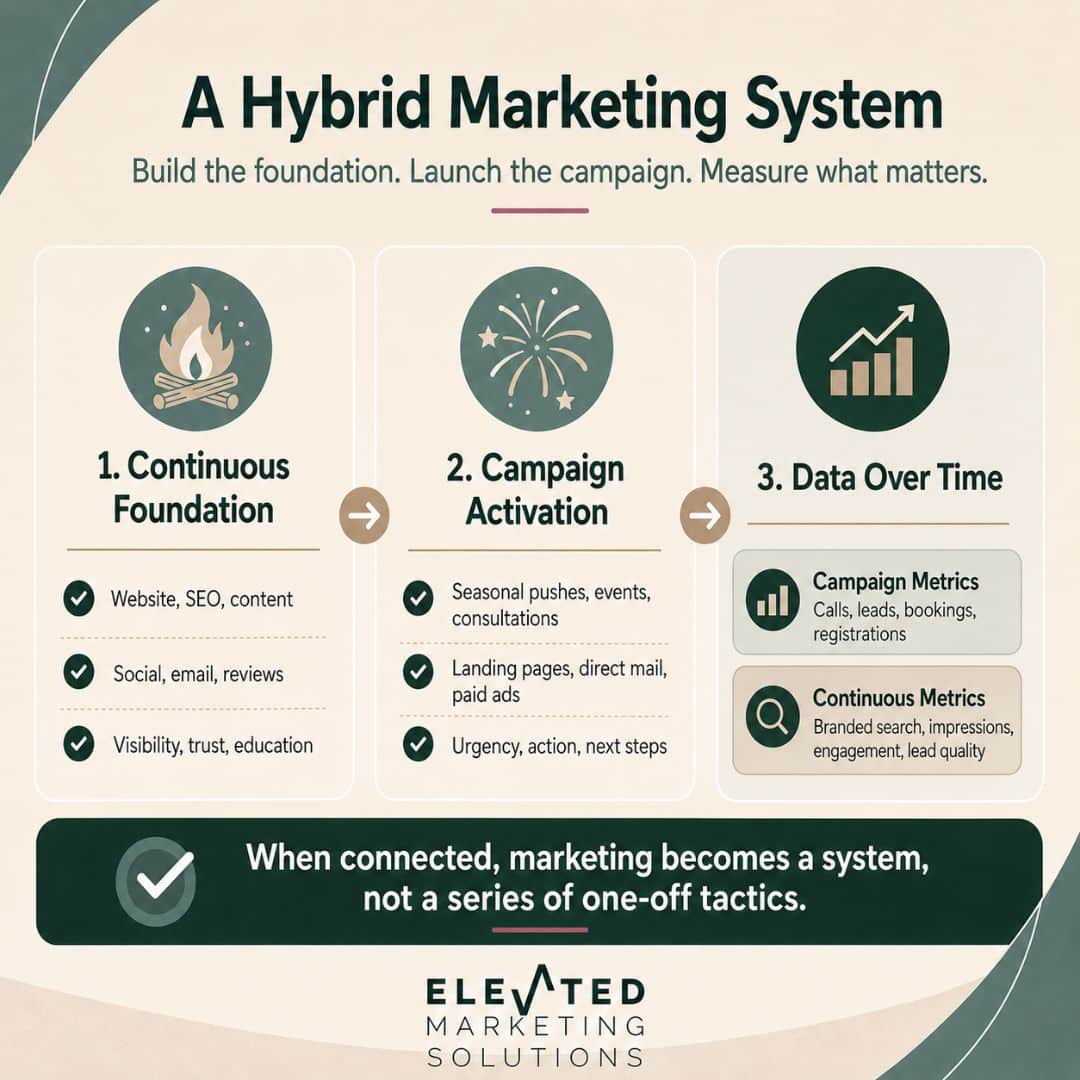
They may see your name in Google search results, read reviews, watch a short video, see a LinkedIn post, hear about you on a podcast, ask ChatGPT or another AI tool for recommendations, and then visit your website days or weeks later by typing in your name directly.
This is why continuous marketing is becoming even more important. It creates the visibility, clarity, credibility, and proof that help your business show up across more places. Your website, content, reviews, social posts, videos, PR mentions, directories, and third-party references all contribute to how your brand is understood.
Campaigns still matter because they give people a reason to act, but they work better when your brand has already been seen, heard, and trusted. This is the reality of modern marketing. Influence often happens before the website visit. It may happen in places that do not immediately show up as a direct conversion. That does not mean the marketing is not working. It means we have to measure more than last-click traffic.
Campaigns and Continuous Marketing Should Not Be Measured the Same Way
One reason businesses get frustrated with marketing is that they measure every activity the same way. Campaigns and continuous marketing have different jobs, so they need different measurements.
Campaigns are usually tied to a specific goal and timeline. Depending on the campaign, you may track landing page visits, form submissions, phone calls, online bookings, event registrations, email clicks, ad clicks, cost per lead, cost per conversion, sales, revenue tied to the campaign, promo code usage, quote requests, return on ad spend, and campaign engagement. These metrics help you understand whether the focused push created action.
Continuous marketing is about building strength over time. You may track organic search impressions, search rankings, branded searches, direct traffic, blog traffic, website engagement, return visitors, email list growth, email engagement, social reach, social saves, social shares, comments, video views, watch time, review growth, referral traffic, Google Business Profile actions, lead quality, assisted conversions, and sales-qualified opportunities.
A campaign may show a fast spike, while continuous marketing shows whether the business is getting stronger. You need both views to understand what is really happening.
The Problem Is Not Campaigns or Continuous Marketing. It Is Disconnection.
Campaigns fail when they are disconnected from the rest of the marketing system. A campaign may struggle if the offer is unclear, the audience is too cold, the landing page does not match the message, the website lacks trust signals, there is no follow-up plan, tracking is not set up, the sales team is not prepared, or the business has been quiet for months before launching the campaign.
Continuous marketing can also underperform when it is disconnected. It may struggle if content is created without a clear audience, social posts do not connect to services or goals, blogs are not internally linked to relevant pages, email marketing does not lead anywhere, website updates are not tied to conversion, there is no campaign calendar, there are no clear calls to action, or the business is active but not strategic.
This is where businesses often get stuck. They are doing marketing activities, but the activities are not supporting each other. The goal is not to do more marketing. The goal is to connect the right marketing activities so they build visibility, trust, action, and measurable growth.
Industry Examples: What This Looks Like in Practice
The right balance of campaigns and continuous marketing depends on the business model, buying cycle, seasonality, and audience. A healthcare practice, event venue, B2B service company, education-based organization, and local service business may all need campaigns and continuous marketing, but the mix will look different.
Healthcare Practice
A healthcare practice may use continuous marketing through SEO-focused service pages, provider bios, patient education blogs, Google Business Profile updates, reviews, FAQs, and social content that builds trust. Campaigns may include back-to-school sports physicals, new provider announcements, seasonal allergy care, flu shot reminders, or location-specific promotions.
The continuous marketing builds trust before a patient needs care. The campaign gives them a timely reason to schedule.
Event Venue
An event venue may use continuous marketing through past event photos, vendor partnerships, SEO for event types, social proof, email list growth, blog content, and testimonials. Campaigns may include wedding season promotions, corporate event packages, open house events, or seasonal booking pushes.
The continuous marketing helps people imagine the experience. The campaign creates urgency around booking.
B2B Service Company
A B2B service company may use continuous marketing through thought leadership, LinkedIn content, case studies, SEO, email nurture, sales collateral, and educational webinars. Campaigns may include a new service launch, industry-specific offer, webinar promotion, consultation campaign, or re-engagement campaign for old leads.
The continuous marketing builds authority. The campaign creates a reason to start a sales conversation.
Education-Based Organization
An education-based organization may use continuous marketing through SEO-focused program pages, student success stories, informational blog content, email nurturing, social media, videos, FAQs, and community partnerships. Campaigns may include enrollment pushes, open house promotions, certification program launches, continuing education opportunities, or reminders around registration deadlines.
The continuous marketing helps prospective students, parents, or professionals understand the value of the program before they are ready to commit. The campaign gives them a timely reason to inquire, register, attend an event, or start the enrollment process.
Local Service Business
A local service business may use continuous marketing through local SEO, Google Business Profile posts, reviews, before-and-after photos, service pages, FAQs, and helpful seasonal content. Campaigns may include spring maintenance, winter preparation, storm response, referral offers, or neighborhood direct mail.
The continuous marketing builds local trust. The campaign captures timely demand.
How to Decide What Should Be Continuous and What Should Be a Campaign
If you are trying to build a better marketing plan, start by separating what needs to happen all year from what needs to happen during specific moments.
What needs to be true all year?
This question points to continuous marketing. If your business needs to be found in search, earn trust before someone calls, explain your services clearly, stay visible in the community, build reviews, educate your audience, or keep past customers engaged, those activities should not be treated like one-time campaigns. They need to be part of the ongoing marketing foundation.
Examples may include SEO, website improvements, social media, email nurturing, review generation, Google Business Profile updates, educational content, customer stories, referral relationships, and reporting.
What happens at specific times of year?
This question points to campaign planning. If your business has seasonal demand, annual events, product launches, enrollment periods, program registration deadlines, fundraising pushes, budget cycles, weather-related services, or specific sales goals, those moments should become campaigns with clear timelines and focused messaging.
Examples may include seasonal promotions, event campaigns, launch campaigns, direct mail drops, limited-time offers, annual appeals, open houses, enrollment campaigns, and retargeting campaigns.
What does your audience need to understand before they are ready to act?
This question usually points back to continuous marketing because it identifies the education and trust-building that need to happen before a campaign can work well. Your audience may need to understand the problem, the process, the value, the investment, the timeline, the difference between options, or the proof that your business can deliver.
Examples may include blogs, FAQs, service pages, comparison content, case studies, testimonials, videos, email nurture, and sales materials.
What should someone do right now?
This question points to campaign strategy because it defines the action you want people to take during a specific moment. If the answer is book, buy, register, request a quote, attend, schedule, call, donate, or sign up, then the campaign needs to make that next step clear and timely.
Examples may include landing pages, promotional emails, ads, social posts, direct mail, website banners, sales scripts, and follow-up sequences.
What happens after someone engages but does not convert?
This question connects both sides. A campaign may create the initial engagement, but continuous marketing helps continue the relationship. If someone clicks, visits, downloads, replies, attends, or asks a question but does not convert, the follow-up strategy determines whether that interest is lost or nurtured.
Examples may include email nurture, retargeting, sales follow-up, additional content, consultation offers, softer calls to action, and future campaign segmentation.
What does success look like?
This question helps determine what to measure. A campaign may need leads, calls, sales, bookings, registrations, or revenue within a set period. Continuous marketing may need visibility growth, stronger engagement, better lead quality, improved conversion rates, more branded searches, stronger reviews, and more assisted conversions over time.
When you know the difference, you can stop expecting every marketing activity to produce the same type of result.
A Simple Hybrid Marketing Checklist
A strong hybrid strategy should include both the steady foundation and the focused pushes. The continuous marketing foundation keeps your brand visible, trusted, and ready to convert interest over time. Campaign planning creates focused moments where the audience is asked to take a specific action.
Your continuous marketing foundation may include clear positioning and messaging, updated website service pages, SEO and content strategy, consistent social media presence, email list growth and nurture, Google Business Profile updates, review generation, website conversion tracking, ongoing reporting, customer follow-up, and sales support materials.
Your campaign planning may include a clear campaign goal, defined audience, specific offer or message, campaign timeline, landing page or website destination, email plan, social content plan, paid ad plan, offline support when relevant, follow-up process, measurement plan, and post-campaign review.
When both sides are planned together, marketing becomes much more effective.
So, Which One Do You Need?
You need both. You need continuous marketing because people need to find you, understand you, trust you, and remember you. You need campaigns because people also need timely reasons to act.
Campaigns create focused moments of action, while continuous marketing creates the trust, visibility, and understanding that make those moments work. When they are disconnected, campaigns feel forced and continuous marketing feels directionless. When they work together, marketing becomes a system instead of a series of one-off tactics.
Marketing is not a light switch you turn on when you need sales. It is a system that should support your business before, during, and after someone is ready to buy.
The businesses that win are not usually the ones running the loudest campaign or posting the most often. They are the ones connecting their marketing activities with a clear strategy. They understand that SEO, content, social media, email, paid ads, website updates, reviews, offline visibility, sales follow-up, and customer experience all play a role.
They use continuous marketing to build the campfire. They use campaigns to create the fireworks. They use data over time to understand what is working, what needs to improve, and where to invest next.
If your marketing feels like it only works in short bursts, or if you are consistently showing up but not seeing action, it may be time to rethink how your campaigns and continuous marketing work together.
At Elevated Marketing Solutions, this is exactly the kind of strategy we help businesses build. Not more random tactics. Not one campaign carrying all the pressure. A connected marketing system built for visibility, trust, leads, and long-term growth.
About the Author

Jennifer Denney has been in digital marketing since 2006 and has seen a wealth of changing landscape in digital marketing. She has seen the rise and fall of many marketing tactics. She is deeply rooted in understanding the metrics that showcase the value of certain types of digital marketing. She produces weekly live shows with Lorraine Ball, solocast with Elevated Marketing Chats, and conducts a weekly podcast called Elevated Marketing Dot Podcast.