Marketing Metrics You Need to Pay Attention to Right Now
Because Clicks Are Not the Whole Story Anymore
If you have that nagging feeling that “marketing used to be easier to measure,” you’re not imagining it.
We’re seeing the same pattern across service businesses, healthcare, and event-driven organizations: your audience is still paying attention, but they’re doing it in more places, and more often without clicking.
We’ve been measurement-first since 2006, and this post is here for the exact moment you pull up your dashboard and think, “Why is traffic flat, but people keep saying they’ve heard of us?” This is the straight answer: visibility and trust are being built off-site, then decisions show up later as branded searches, direct visits, better leads, and cleaner sales conversations.
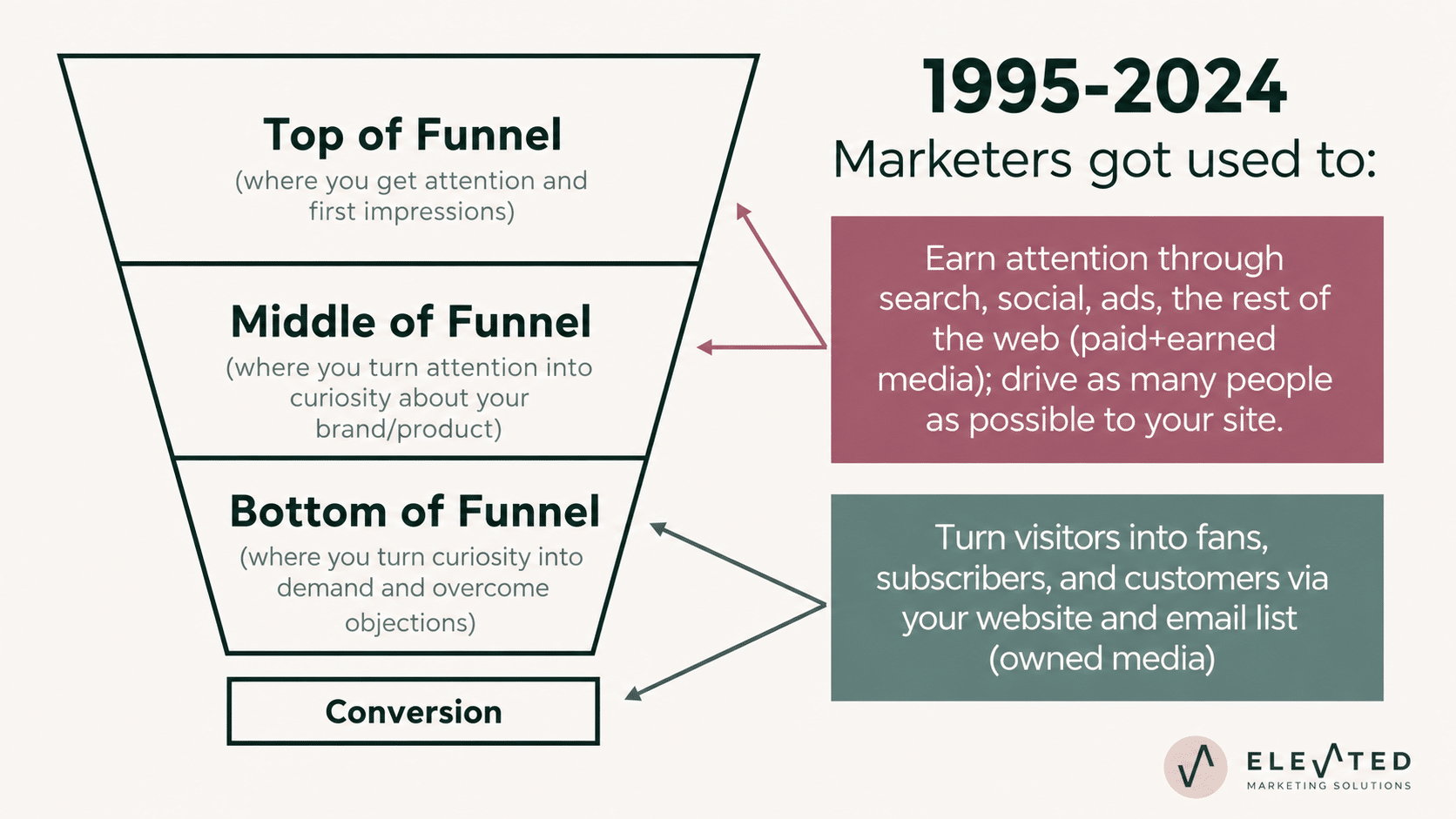
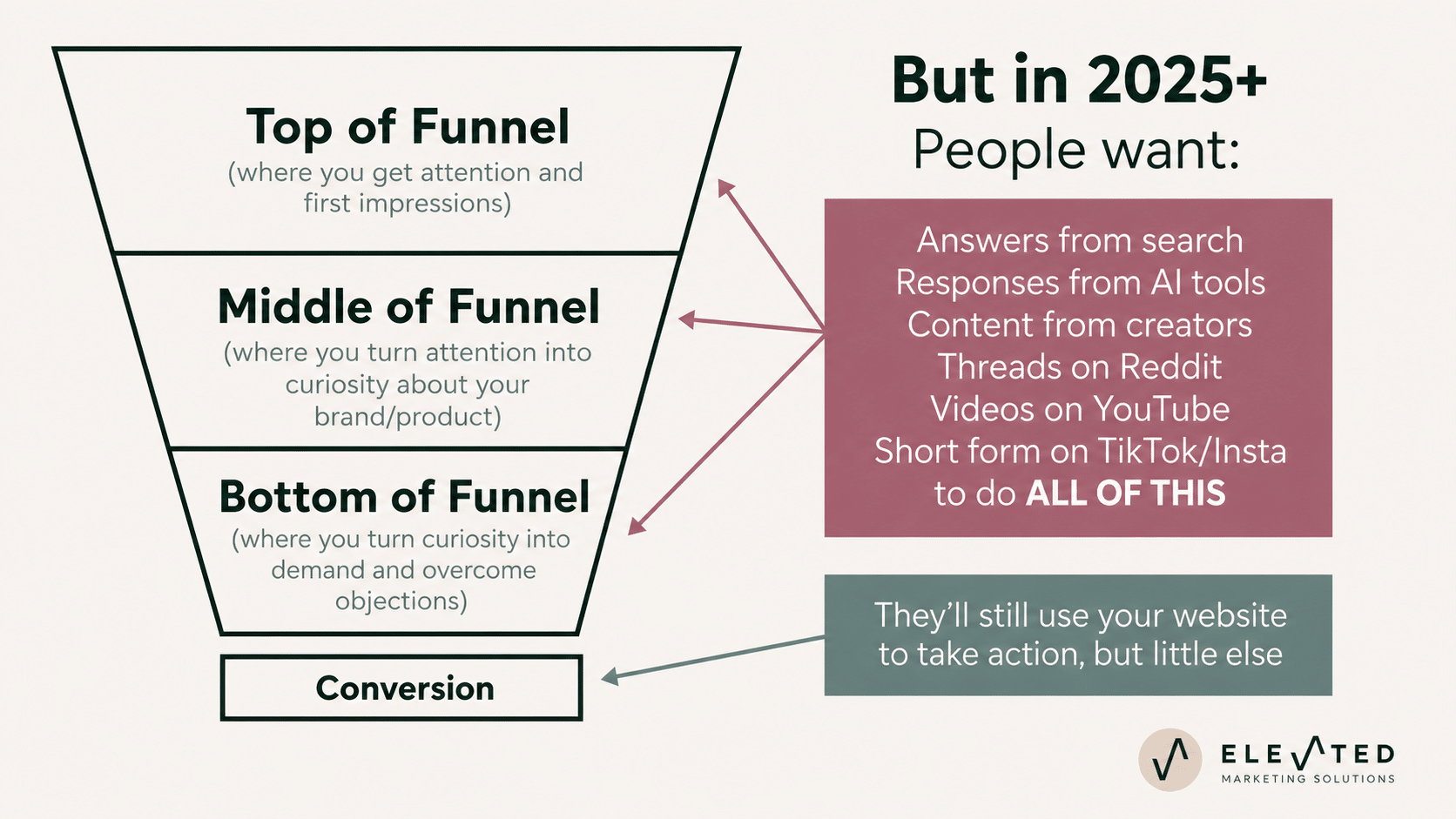
We didn’t create these graphs we’re going to be honest about that but we 100% stand behind them. The team over at Sparktoro so plainly put them together that we quite frankly can’t unsee it. They easily explain what’s happening and what you need to pay attention to win the marketing game in todays’ time.
Why this matters (and why traffic can drop while marketing gets stronger)
For years, the default scorecard was simple: did people click to the website, yes or no?
Now, a big chunk of discovery happens somewhere else first. People compare you in search results, scan reviews, watch short videos, read a LinkedIn post, hear a podcast clip, see a Reddit thread, or get an AI-generated summary that answers their question before they ever visit your site.
Google’s AI Overviews are literally designed to provide an AI-generated snapshot with links, which often reduces the need to click around like we used to. And the broader “zero-click” behavior is real: more searches end without a click because the results page satisfies the intent on its own.
So if you only measure clicks, you’ll talk yourself into bad decisions:
- you’ll cut the content that’s building trust,
- you’ll overfund “tactics that spike traffic” even if they attract the wrong people,
- you’ll miss the early signals that your brand is becoming the default choice.
The website still matters, because it’s where action happens. But the attention, the comparison, and the trust-building often happen elsewhere.
What’s actually going on (the shift you need to accept)
Here’s the cleanest way to frame it:
Old mindset: “How many people clicked to the website?”
New mindset: “Are we becoming more visible, trusted, cited, remembered, and chosen across the places people now make decisions?”
When that’s your lens, your metric stack has to change. You still track conversions/key events, of course. But you also track the signals that show you’re winning mindshare before the click, and influence after the click.
What usually goes wrong when people try to measure this
When we audit reporting for new clients, the same failure patterns show up:
They treat the website as the only arena.
So anything that happens in social, video, AI answers, reviews, podcasts, partner mentions, or community conversations gets ignored, even though that’s where the buyer is warming up.
They obsess over volume, not quality.
Traffic becomes the goal, not the outcome. The result is a lot of “busy” marketing that doesn’t translate into better leads or better sales conversations.
They track last-click and call it attribution.
That’s how you end up killing the channels that create demand, just because they don’t get the final click.
They never define what a meaningful action is.
If GA4 is not set up with the right key events, you’re basically reading tea leaves and calling it reporting.
What we do instead (how to measure modern marketing without losing your mind)
We use a simple hierarchy:
- Demand signals (Are more right-fit people becoming aware of you?)
- Trust signals (Are others validating you, referencing you, and choosing you faster?)
- Conversion signals (Are the right people taking the right actions?)
- Revenue signals (Is this creating qualified pipeline and better sales outcomes?)
That keeps you from overreacting to a traffic dip while your brand is actually gaining ground.
The metrics that matter now (and how to interpret them)
I’m going to group these so you can actually use them, not just screenshot them.
1) Brand demand and “I’ve heard of you” momentum
Branded search volume
Are more people searching your company name, service lines, leadership names, podcast name, or branded phrases? This is one of the cleanest signals that your marketing is creating recall.
Direct traffic trends
Direct traffic is messy, but directionally useful. If more people are typing your URL or coming back intentionally, it usually pairs with growing awareness elsewhere. Plus we can’t ignore that more and more Google is putting traffic not traditionally found in search engines in direct traffic. Just make sure quality and you are also seeing good engagement metrics between 40-60%
Customer source feedback
Ask every new lead: “How did you hear about us?” Then write down the real answer. When you start hearing “I saw you on LinkedIn,” “I heard the podcast,” “I kept seeing you when I searched,” or “ChatGPT mentioned you,” your measurement model has to evolve with reality. This is going old school but is going to give you more of feel than any dashboard because it’s real to your clients.
2) Search visibility without the click (the new SEO reality)
Search impression growth (Google Search Console)
Even when clicks soften, impressions can climb. That tells you your content is being surfaced, even if the answer is happening on the results page now.
Measure what AI can actually send you: referral traffic and on-site behavior
If AI tools, AI-powered browsers, or AI search experiences do send traffic, it may show up as referral traffic (sometimes clearly, sometimes lumped into “direct” or “unknown”).
Measure your “source readiness” instead of chasing mention counts
This is the part most people miss. The goal is not to win a popularity contest inside AI tools, it’s to make your content easy to pull from, accurate, and trustworthy when it is pulled.
So you track whether your website and content are structured like a source:
- Your key pages answer specific questions clearly, with plain language
- Your service pages are explicit about who you help, what you do, where you operate, and what to do next
- Your content has consistent terminology, updated details, and obvious authority signals (credentials, bios, citations, testimonials, policies, etc.)
- Your brand footprint across the web is consistent (listings, bios, About pages, profiles)
Spot-check AI presence the same way you’d audit reputation
You treat it like a periodic audit, not an always-on metric.
Once a month or once a quarter, run a consistent set of prompts across a few tools and record what you see:
- Are you mentioned at all for your category and geography?
- Are competitors mentioned instead?
- If you are mentioned, is it accurate?
- What sources does it cite or reference, if any?
- Are there obvious gaps you can fix on your site (missing explanations, unclear service areas, thin pages)?
This is qualitative, but it’s still useful. It produces an action list, not a vanity graph.
3) Content and social that actually signals intent (not just “engagement”)
Social reach and engagement quality
Likes are cheap. The stronger intent signals are saves, shares, comments with substance, profile visits, follows, DMs, and meaningful conversations that sound like, “We’ve been watching you for a while.”
Video performance that shows attention
Track retention, completion rate, replays, saves, shares, and comment quality. Video is often the trust-builder, not the closer. You’re watching for “this is resonating” signals, not just views.
Thought leadership engagement
On LinkedIn and similar channels, pay attention to post impressions, profile views, comment threads, newsletter subscribers, and inbound requests like speaking, partnerships, or “can you look at our situation?”
4) Third-party validation and “people trust you without knowing you”
Review growth and sentiment
Review volume is nice. Review language is better. Are people using words like “trust,” “responsive,” “results,” “professional,” “explained it clearly,” and “made it easy?” That language tells you what your market believes about you.
Content mentions and citations
Are other websites, creators, newsletters, podcasts, community threads, or industry posts referencing your brand? In the current landscape, being cited is a ranking factor in the real world, even when it’s not a literal SEO metric.
Brand trust assets
Testimonials, case studies, PR mentions, backlinks, expert quotes, third-party validation. These aren’t “nice-to-haves” anymore, they’re conversion accelerators.
5) Website performance that matters (GA4 signals tied to outcomes)
This is where the website still earns its keep: turning warmed-up attention into action.
Engaged sessions (GA4)
GA4 defines an engaged session as one that lasts longer than 10 seconds, has a key event, or has at least 2 pageviews or screenviews.
This is a better baseline than raw sessions because it filters out a lot of junk.
Key events (formerly conversions)
GA4 uses “key events” for what many people still call conversions.
Track actions that mean something for your business: calls, form submissions, booking clicks, email link clicks, downloads, quote requests, video views on key pages, and other “hand-raise” behavior.
Conversion rate and lead quality
If traffic drops but conversion rate rises, you might be attracting better-fit prospects. If lead quality rises, your marketing is doing its job even if the sessions chart looks less exciting.
Assisted conversions and pipeline influence
Look at the touchpoints people interacted with before converting, not just the last click. This is how you protect demand gen channels that don’t “close,” but clearly influence.
Referral traffic quality
Directories, partner sites, podcasts, newsletters, PR mentions, social platforms, and yes, AI-driven referrals when you can identify them. Don’t judge by volume alone, judge by whether those visitors behave like buyers.
6) Owned audience strength (because rented attention is fragile)
Email list growth
If people are not ready to convert, the next best outcome is permission to stay in their world. You own your email marketing list and it should be growing.
Newsletter engagement
Opens and clicks matter, but pay extra attention to replies, forwards, and what topics create actual conversation. That’s voice-of-customer intelligence you can reuse everywhere.
What to measure and how to interpret it (the “don’t panic” scorecard)
If you want a simple operating rhythm, use this:
- If branded search + direct traffic + review momentum are rising, marketing is building demand and trust.
- If impressions are rising while clicks soften, your visibility is improving in a zero-click world.
- If engaged sessions + key events + conversion rate are improving, your site is doing its job with the right visitors.
- If lead quality + sales cycle quality are improving, marketing is influencing revenue, not just activity.
That’s the real measurement stack now: not “did they click,” but “are we being chosen more often, with less friction.”
What to do next (a practical reset you can apply this month)
Start with these three moves:
1) Define your “meaningful actions” and mark them as key events in GA4.
If you don’t decide what matters, GA4 will happily show you a lot of noise.
2) Build a visibility dashboard next to your conversion dashboard.
One view that includes branded search trend, Search Console impressions, review volume and sentiment, social and video intent signals, and mentions or citations.
3) Align marketing reporting to pipeline, not just web analytics.
Track booked calls, qualified opportunities, proposals, and closed revenue influenced by marketing. Even a simple monthly “what changed in pipeline” note beats a pretty traffic chart.
If you want help setting this up without turning it into a 40-tab spreadsheet, that’s the kind of measurement-first work we do at Elevated. Not to make reports look good, but to make decisions obvious.
What you’re probably wondering right now
“Is website traffic still important?”
Yes, but it’s no longer the only proof of performance. The site is where action happens, but discovery and trust-building often happen before the site visit.
“Why are impressions up but clicks down?”
Because search behavior is shifting toward zero-click experiences and AI-generated summaries. Your content can be seen and used without earning the click.
“What’s the single best early indicator that marketing is working?”
Branded search trend is one of the cleanest demand signals, especially when it pairs with stronger lead quality and more direct visits.
“What should we count as a key event in GA4?”
Actions that indicate intent: calls, form submits, booking clicks, quote requests, key downloads, and other hand-raise behavior. GA4’s terminology is “key events,” and it replaced what many people called conversions.
“What is an engaged session, and why should I care?”
GA4 counts a session as engaged if it lasts longer than 10 seconds, includes a key event, or includes at least 2 pageviews/screenviews. It’s a better quality filter than raw sessions.
“How do we measure AI visibility if analytics doesn’t show it clearly?”
You can start by checking whether AI tools mention your brand, cite your content, or summarize pages that you control. You’re watching for presence, accuracy, and whether your content is being used as a source.
“If clicks are down, should we cut SEO or content?”
Not automatically. First check branded search, impressions, conversions, lead quality, and pipeline influence. Cutting the content that creates trust is how you lose the long game.
Clicks still matter, but they’re not the whole game anymore. Your best signal of marketing health now is whether you’re becoming the brand people recognize, trust, and choose before they ever fill out a form, and you can see that in the trail it leaves behind: more branded searches, more direct visits, better reviews, stronger engagement, higher-quality leads, and a sales cycle that feels less like convincing and more like confirming. If your reporting only tells you what happened on your website, it’s going to miss the real story. Build a scoreboard that measures visibility, trust, and pipeline influence together, then make decisions based on whether you’re getting remembered and recommended in the places your buyers actually make up their minds.