Posting Every Week but No Calls? A Practical Social Media Strategy for Service Businesses

If you run a service-based business, you’ve probably had the same annoying experience: you post consistently, the account looks “active,” and it still doesn’t turn into customers.
We see this a lot in our agency work with service businesses, especially local and regional teams where reputation matters, timing matters, and your next customer is usually comparing two or three options before they ever reach out. This guide shows you what to post, why it works, and how to turn social media into calls and bookings instead of just engagement.
Why you’re posting, but it’s not turning into customers
Most service business content fails because it’s built to fill a calendar, not move a buyer toward a decision.
When someone hires a service provider, they’re trying to answer a few questions before they contact anyone:
Do I need this?
Can I trust this company?
Do they understand my problem?
Are they worth the cost?
What happens after I contact them?
If your social content doesn’t answer those, you can post every day and still get nothing but polite likes from people who were never going to buy.
What “effective” social media actually means for service businesses
Effective social media for service businesses is not about being clever, trendy, or constant.
It’s about doing three things consistently:
- Making the right buyer feel like you understand their situation.
- Reducing the risk of reaching out.
- Making the next step obvious, call or book.
That’s the strategy. Everything else is execution.
The content mix that works for service-based businesses
A service buyer is not looking for entertainment first. They’re looking for clarity and confidence. That’s why your content mix should lean heavier on education,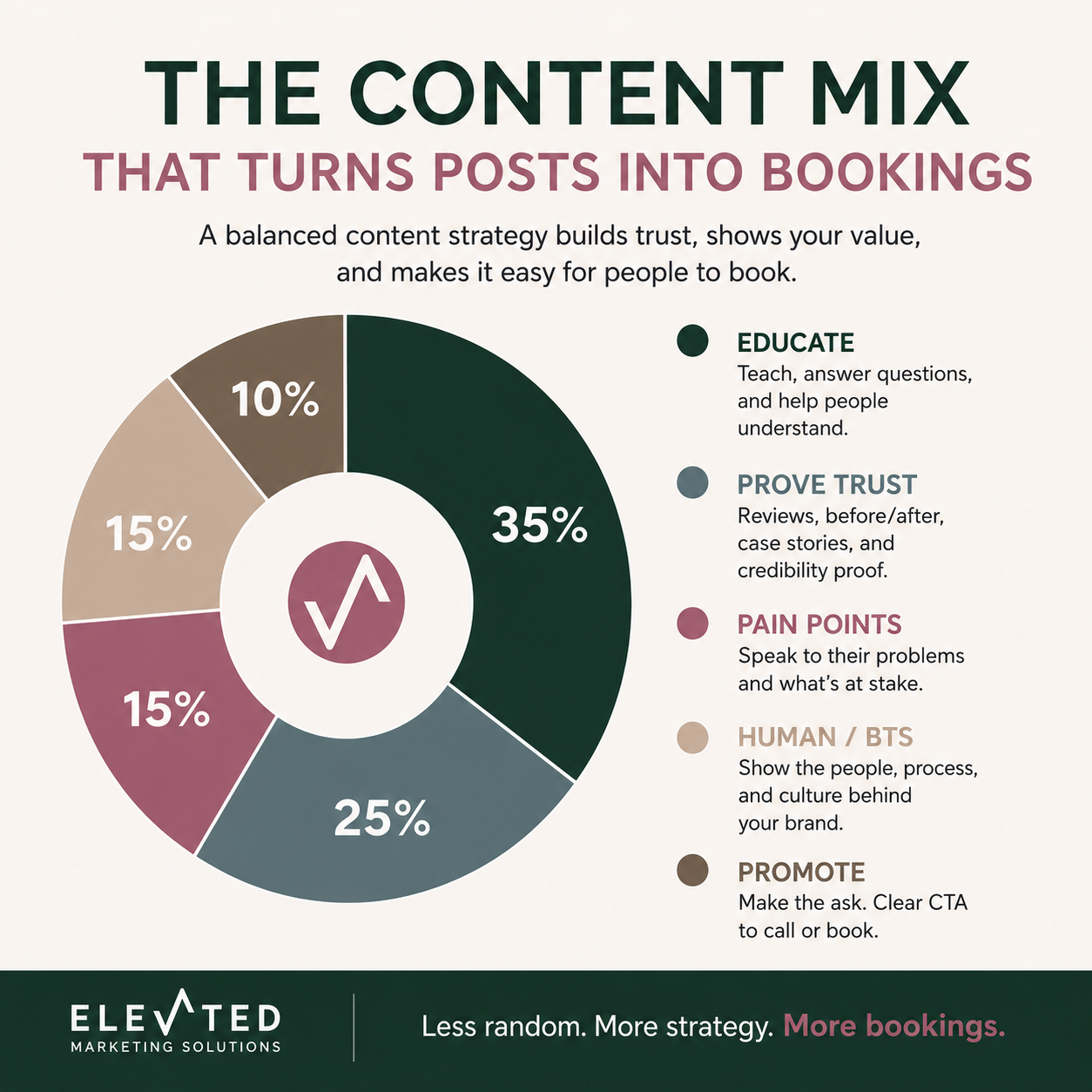 proof, and conversion than most people expect.
Here’s the mix we use as a baseline:
- Educational / Helpful: 30–40%
- Proof / Results / Trust-building: 20–25%
- Problem-aware / Pain point content: 15–20%
- Human / Community / Behind-the-scenes: 10–15%
- Promotional / Conversion-focused: 10–15%
The point of this mix is simple: help someone move from problem-aware to ready to inquire, not just “stay consistent.”
What to post in each category, so it leads to calls and bookings
Educational content: help them make a decision, not just learn something
Educational content should help your audience understand the problem, the process, the timeline, and the decision they’re making.
Examples that consistently work for service businesses:
- How to know when it’s time to call
- What causes the issue you fix
- What happens if you ignore it
- What affects cost, and why prices vary
- What to expect on the first call, consult, or appointment
- Questions to ask before hiring a provider
- DIY vs professional, when you should stop trying to fix it yourself
- Common mistakes people make that make the problem worse
- How to compare quotes the right way
If you want this category to convert, keep it specific. Talk like you’re answering one real customer’s question, not “educating the internet.”
Proof content: remove the fear of picking the wrong provider
Most customers are not thinking, “Are these people nice?” They’re thinking, “Am I going to regret hiring them?”
Proof content can be:
- Reviews and testimonials with a sentence of context
- Before and afters
- Mini case stories (problem, what you did, what changed)
- Photos or short videos of the process
- Credibility signals that matter in your industry (experience, training, standards, safety, guarantees, what you do differently)
A simple upgrade most service businesses miss: don’t just post the review. Add why it mattered. What was the customer dealing with, what did you do, and what did the outcome look like?
Pain point content: make the right people stop scrolling
This is the content that makes your ideal customer think, “That’s exactly what’s happening to me.”
Good pain point posts are practical, not dramatic:
- “If you’re noticing X, it usually means Y.”
- “If you tried this and it didn’t work, here’s why.”
- “If you’re putting this off, here’s what it often turns into.”
- “This is the mistake that adds time and cost.”
You’re not trying to scare people. You’re helping them name the problem so they can act.
Human and behind-the-scenes: make it feel safe to contact you
For service businesses, human content is not about being cute. It’s about showing competence, standards, and what it’s like to work with you.
This category builds comfort:
- A day-in-the-life that shows how you work, not just jokes
- Team spotlights that connect to expertise and care
- “Here’s how we communicate and what to expect”
- Community involvement if it fits your brand and market
- Process moments that show cleanliness, precision, respect for the customer’s space, and consistency
People hire people. They also hire systems. Show both.
Promotional content: convert without sounding desperate
Promotional posts are necessary, but they work best when your audience already trusts you and understands what you do.
Keep promos simple:
- One clear offer
- One clear next step
- Consistent language for 60 to 90 days
Instead of reinventing your CTA every post, train your audience. You want them to know exactly what “work with us” looks like.
The conversion path, the part most service businesses forget
The content mix is only half the system. The other half is the handoff.
If your posts say “Book now,” but your link drops people on a confusing homepage, you created friction and called it marketing.
For a service-based business that wants calls and bookings, your conversion path should be tight:
- Your posts point to one primary action: call or book
- Your booking link goes to a page that matches what you’re talking about
- The page sets expectations: what happens next, how fast you respond, what they need to bring, and who it’s for
Offer language that makes booking easier
Most service businesses lose leads because the CTA is vague. People don’t want to “DM to learn more.” They want to know what they’re stepping into.
Use offers that feel low-risk and clear, like:
- “Book a 15-minute assessment call”
- “Request a quote”
- “Schedule an on-site evaluation”
- “Get a second opinion”
- “Book a consult and we’ll give you a clear next step”
A weekly posting cadence your team can actually follow
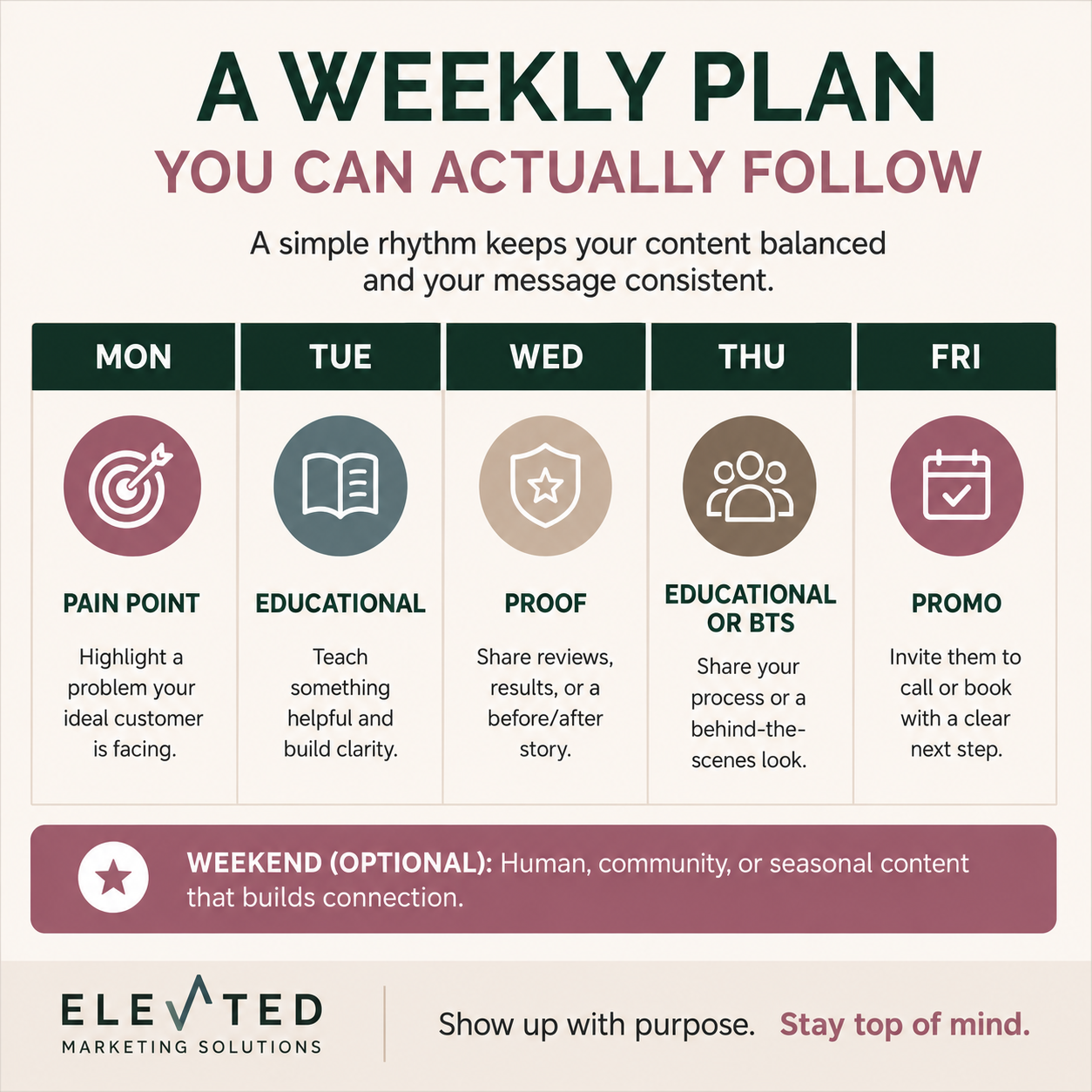 Percentages are helpful, but execution gets easier when you translate the mix into a repeatable week.
Here’s a clean weekly rhythm that works for most service businesses:
- Monday: Pain point (problem-aware)
- Tuesday: Educational
- Wednesday: Proof (review, before/after, mini case)
- Thursday: Educational or behind-the-scenes process
- Friday: Promotional (call or book)
- Weekend (optional): Human or community
This stops you from posting whatever you can think of that day, and it keeps your content balanced without overthinking.
Common hang-ups we see
Why am I getting engagement, but not leads?
Usually you’re attracting non-buyers, or you don’t have enough proof content to reduce risk, or your CTA and booking path are unclear.
How often do I need to post?
Often enough that you stay present, but not so much your quality collapses. Three to five strong posts a week can work if the content mix is right and the conversion path is clear.
Do I need to be on every platform?
No. You need to be consistent where your buyers actually pay attention, and make it easy to call or book from there.
Alright, here’s a clean, proper ending you can drop straight onto the blog post.
Where service businesses win on social
If you’re posting consistently and not getting customers, it’s usually not because social media “doesn’t work.” It’s because your content is doing the wrong job.
For service-based businesses, your content has to help someone make a decision. That means you stop trying to be random and “consistent,” and you start building trust on purpose.
Keep it simple:
- Educate so people understand the problem, the timing, the process, and what affects cost.
- Prove it so they feel safe picking you, reviews, before/after, mini stories, and process proof.
- Hit the pain point so the right buyer recognizes themselves and stops scrolling.
- Humanize the brand so you feel real, competent, and easy to work with.
- Promote clearly so they know exactly what to do next, call or book.
Then, tie it all together with the part most businesses skip, a clean conversion path. One clear offer, one consistent CTA, and a simple handoff that makes it easy to contact you without friction.
If you do that, social media stops being a content chore and starts functioning like a sales assistant, warming people up, building confidence, and teeing up the conversation before they ever reach out.
A simple next step
Pick one service you want to sell more of this month. Post five times using the mix, two educational, one proof, one pain point, one promotional. Make sure every post points to the same next step: call or book. Then use the same simple DM and phone flow to move people from “interested” to scheduled.
That’s how you turn social from “we’re posting” into “we’re getting inquiries.”