Query fanout, how to show up in AI answers
without forgetting the human

I’ve been in marketing for more than 25 years, basically since the early days when Google was teaching all of us what “search” even meant. I’ve watched the industry cycle through every phase, keywords, links, content volume, and every other tactic that worked right up until it didn’t.
I can’t tell you how many times I’ve watched the same movie play out. A tactic works, everyone piles on, agencies build services around it, and then the platform tightens the screws. The only consistent win is staying anchored to the customer while you adjust to the next layer of how search works.
We’re in that moment again. With the latest and greatest of AI optimizations. Today I want to talk about “query fan outs”. The latest term to hit marketing.
Between ChatGPT and Google AI Overviews, a growing share of your prospects are getting their first answer from an AI summary, not from your site. If you’re a marketer, you’ve probably already felt the punchline: your content can be solid, your SEO can be “fine,” and you still don’t show up in the answers that are shaping opinions.
That’s where a newer concept called query fanout becomes useful. It helps you understand why “good content” can still get ignored, and what adjustments actually move the needle, without turning your site into robotic AI bait.
What “query fanout” actually means in plain English
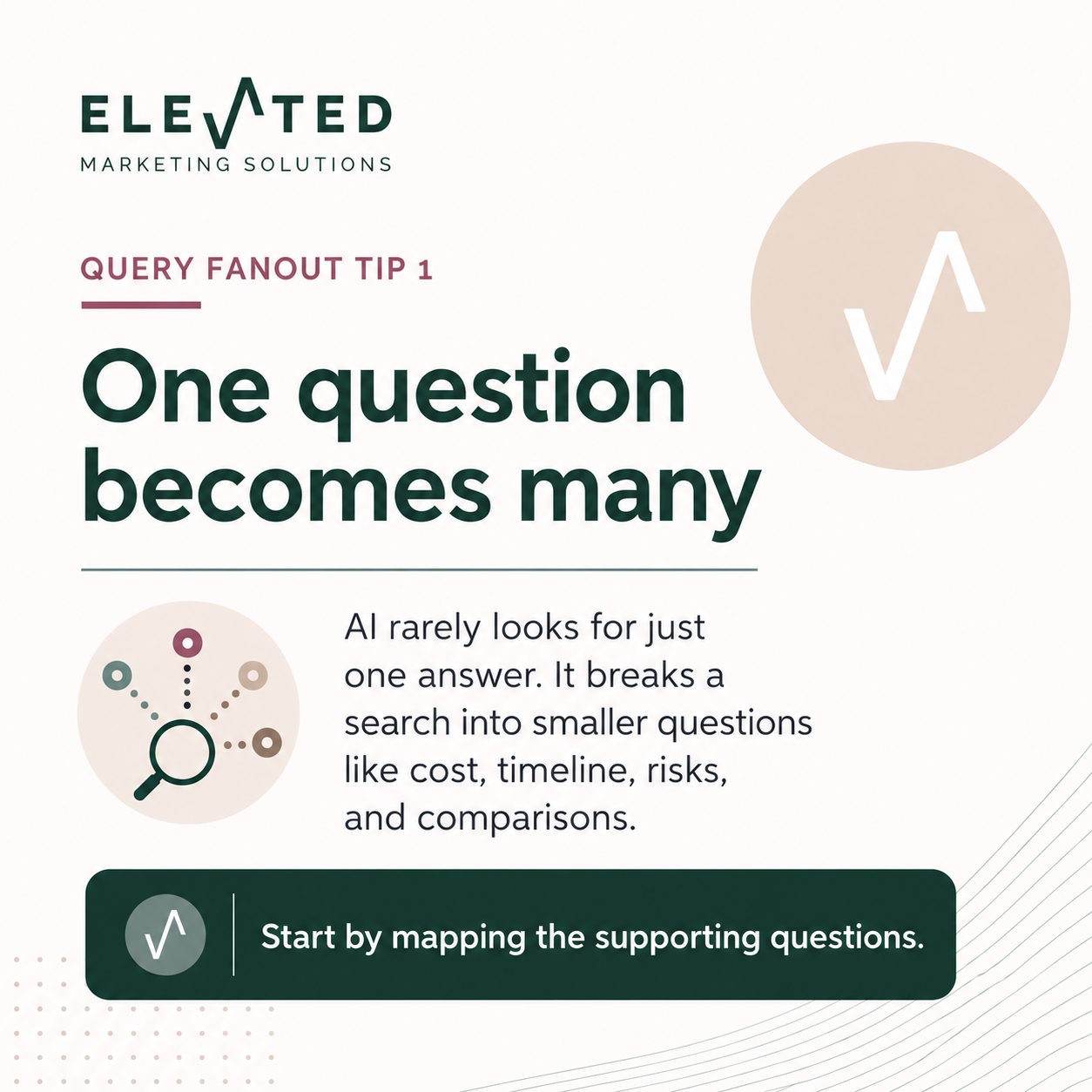 When someone asks an AI a question, the AI rarely runs just one search.
It breaks the question into a bundle of smaller, related searches, pulls information from multiple sources, then stitches an answer together. That bundle is the fanout. (Search Engine Land)
So if someone asks, “What’s the best way to choose a vendor for X?”, the system may quietly branch into sub-questions like pricing drivers, timelines, selection criteria, red flags, and alternatives.
If your site only covers the headline topic, but not the supporting answers, you can be invisible even if your classic SEO is “fine.”
Why fanout matters more now with ChatGPT and Google AI Overviews
Google has been explicit that AI features in Search, including AI Overviews and AI Mode, can use content from across the web and that these experiences include links for people to explore. (Google for Developers)
At the same time, user behavior changes when an AI summary appears. Pew’s analysis of March 2025 browsing data found that when an AI summary was present, users clicked traditional search results less often (8% of visits vs. 15% without a summary). (Pew Research Center)
So “visibility” now means two things:
- Getting cited so you’re part of the answer
- Still being worth the click, because the human has the money, not the model
The human-first warning: how you over-optimize for AI and lose the customer
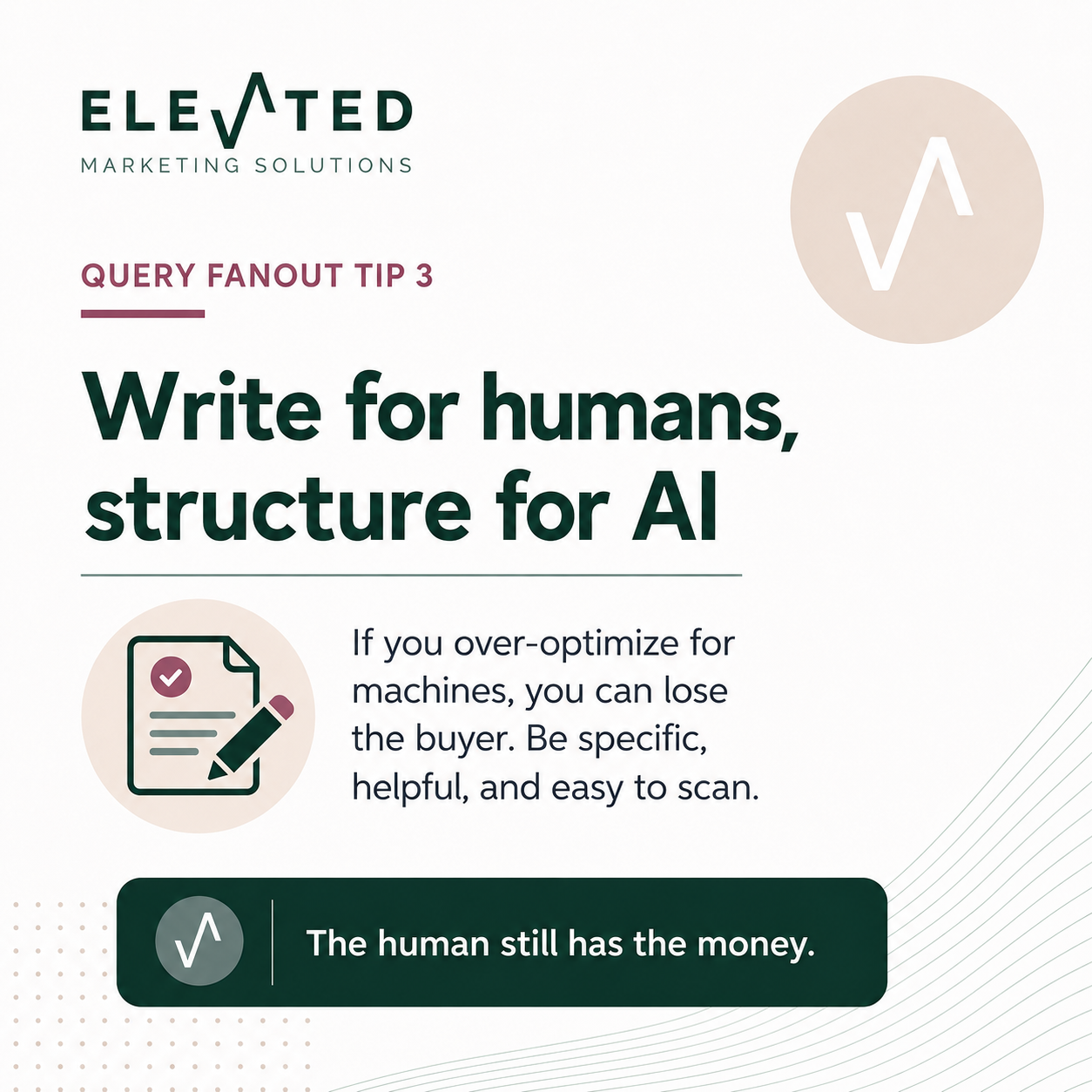
Here’s the trap: you notice AI answers, you start writing to be cited, and suddenly your pages read like they were built to feed an extractor.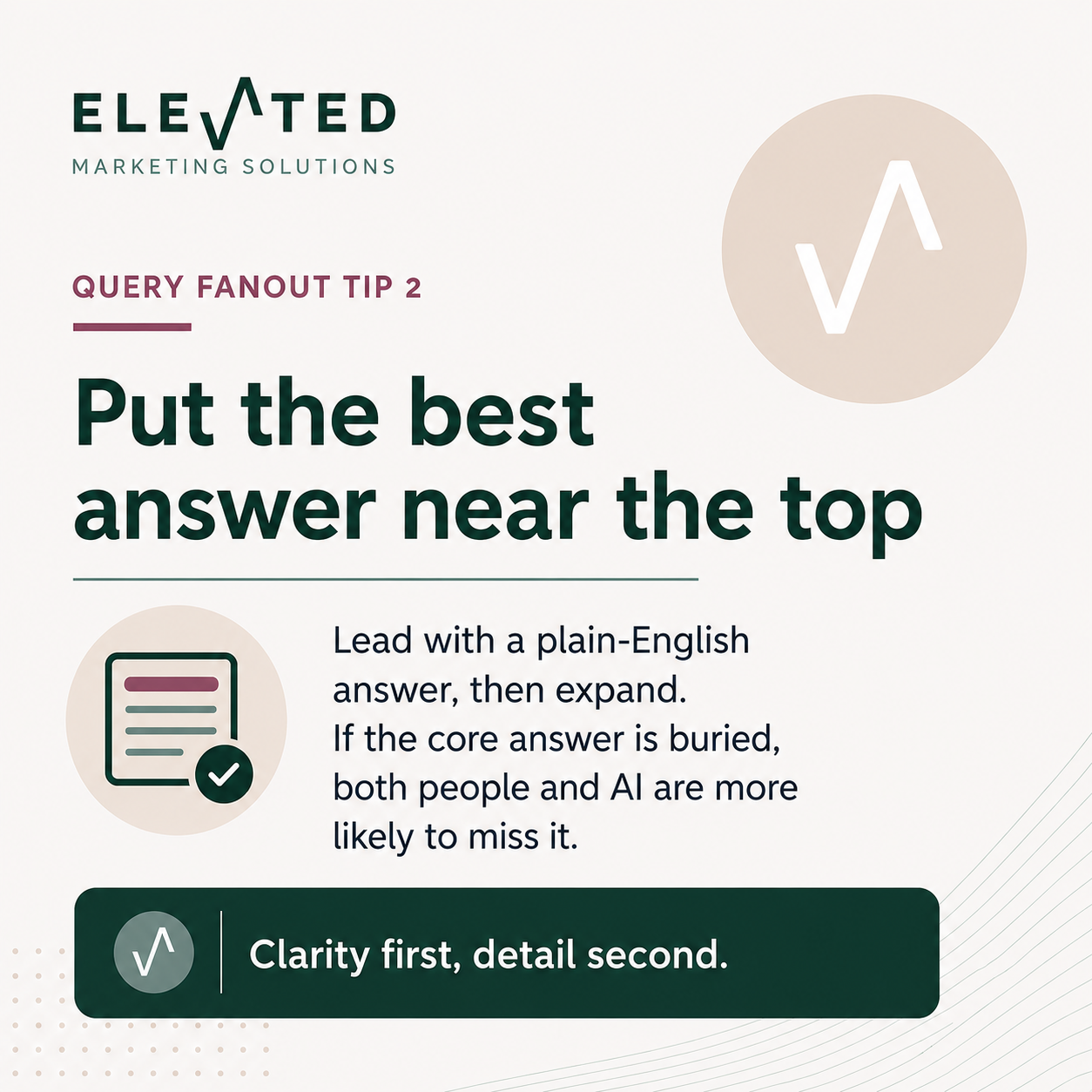
That can backfire fast.
Yes, you want clean, extractable sections. But if your content loses clarity, empathy, real-world tradeoffs, and the “I trust these people” feeling, you might earn a citation and still lose the sale.
The goal is not AI-first content. The goal is helpful content that happens to be easy to cite.
What kinds of fanout patterns can you optimize for?
Think of these as the “supporting questions” an AI goes hunting for after the main question shows up. You do not need all of these for every topic, but most buying journeys hit several.
Definition fanout: What is X? What does X mean? How does X work?
Comparison fanout: X vs Y, alternatives to X, pros and cons, “best option for…”
Cost and value fanout: How much does X cost? What affects price? What’s included? Is it worth it?
Process fanout: Steps, timeline, what happens next,what to expect.
Requirements fanout: Who it’s for, who it’s not for, prerequisites, eligibility.
Risk and downside fanout: Tradeoffs, limitations, what can go wrong, what to watch out for.
Proof fanout: Does it work? What outcomes are realistic? What evidence exists?
Troubleshooting fanout: Why isn’t this working? Common mistakes. Fixes.
Selection fanout: How to choose, what to ask, red flags, evaluation criteria.
Context fanout: For small teams, tight timelines, specific constraints, special situations.
Policy and compliance fanout: What’s allowed, what’s required, what to document, what rules apply.
Integration fanout: Works with, compatible with, implementation gotchas, setup steps.
Language and intent fanout: Ten humans ask the same question ten different ways.
If you only remember one thing, remember this: fanout is mostly supporting questions. Your job is to be the best supporting answer, not just the loudest headline.
Wait, isn’t this just the pillar page strategy we’ve always done?
You’re not wrong to see the overlap. Pillar pages and fanout rhyme, but they optimize for different things.
A classic pillar and cluster strategy is a site
takes one question, breaks it into sub-questions, then goes looking for the best passages to answer each part, and it may cite sources based on how directly and cleanly a section answers one of those sub-questions. (Search Engine Land)
architecture play. You create a hub page for the main topic, spokes that go deep on related subtopics, and internal links that help search engines understand coverage and authority.
Query fanout is a retrieval behavior play. The AI
Here’s the practical difference you can feel when you write:
- Pillar thinking tends to produce comprehensive pages that “cover everything.”
- Fanout optimization makes sure your pages contain multiple best-answer blocks that are easy to extract and cite.
If pillar strategy is “build a great library,” fanout is “make sure every chapter has quotable lines.”
Why your content isn’t getting cited in AI answers
These are the citation-killers we see most often on service pages and blogs.
Your page is “about” the topic, but it doesn’t answer anything cleanly. The content might be accurate, but it’s not extractable.
You bury the actual answer. If your best explanation is halfway down the page, you’re making it harder for both humans and systems to grab the right chunk.
You avoid specifics to sound premium. Unfortunately, AI cites specifics, and humans buy specifics.
Your headings are decorative, not functional. “Our Approach” tells the AI nothing. “How long does this take?” tells it exactly what that section solves.
It’s brochure copy. The page is trying to convince, not clarify. AI answers prioritize clarity.
There are no trust signals. No author expertise, no constraints, no tradeoffs, no “here’s what tends to happen.”
It’s generic. If twenty other pages say the same thing, there’s no reason to cite you.
You don’t cover the adjacent sub-questions. Fanout beats you with breadth.
Your internal linking is weak. You’re not building clear hubs and spokes that make it easy to traverse your “answer network.”
How to optimize for query fanout on service pages
Treat your service page like a source page, not a pitch deck.
A layout that tends to work, and still reads like it’s for humans:
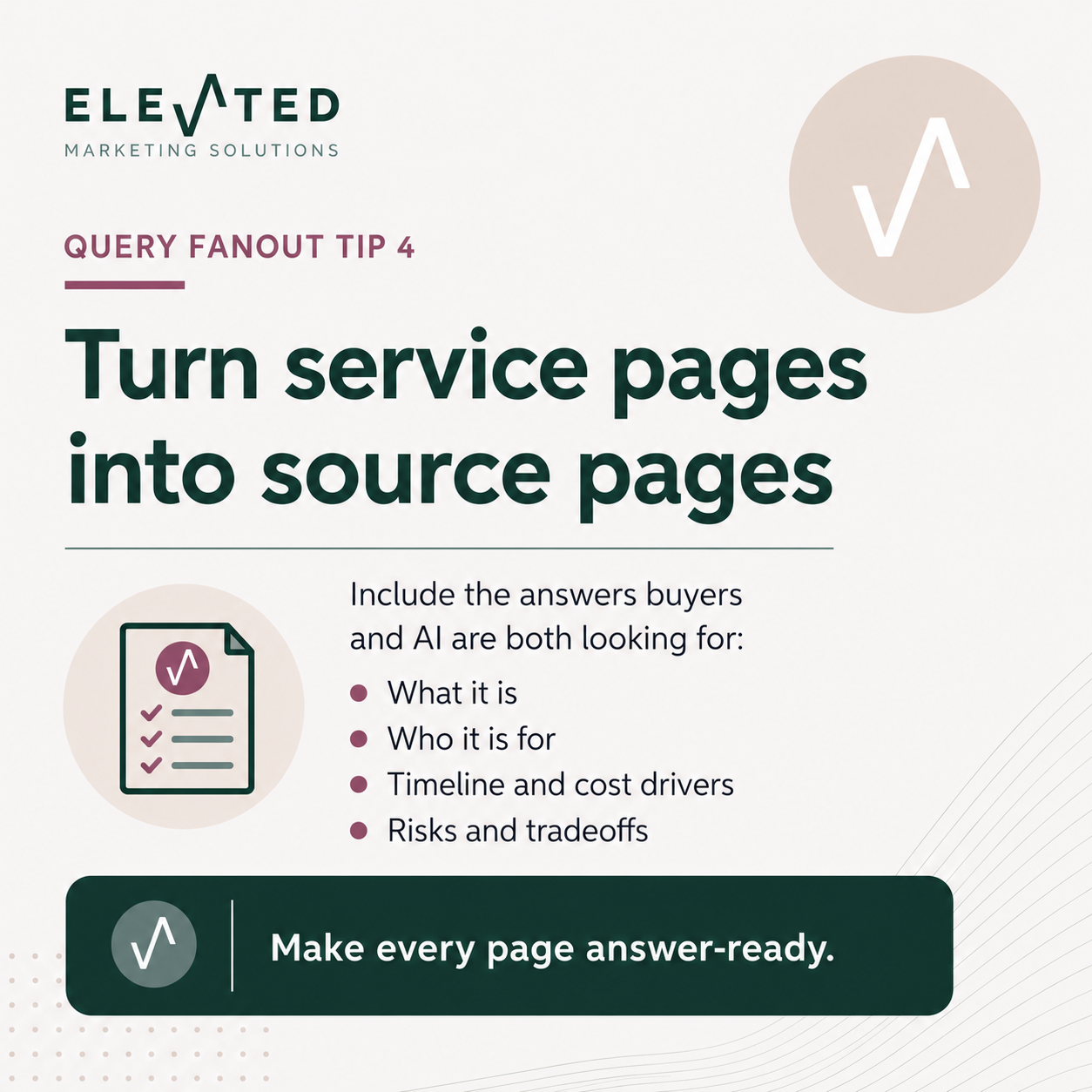
Start with a plain-English definition of the service, including what it is and what it’s not. Then immediately add who it’s for and who it’s not for, because that builds trust fast and filters the wrong leads.
After that, cover outcomes and what affects them, then process and timeline, then cost drivers and what’s included, then risks and tradeoffs. Yes, include tradeoffs. It helps humans decide, and it makes you cite-able because it’s real.
Finally, add short question-style sections that match the fanout patterns above, and link to deeper blog posts for each major sub-question.
The key move: answer each question in a tight, direct paragraph first, then expand. Humans get clarity. AI gets an extractable block.
How to optimize for query fanout on blogs without writing 200 random posts
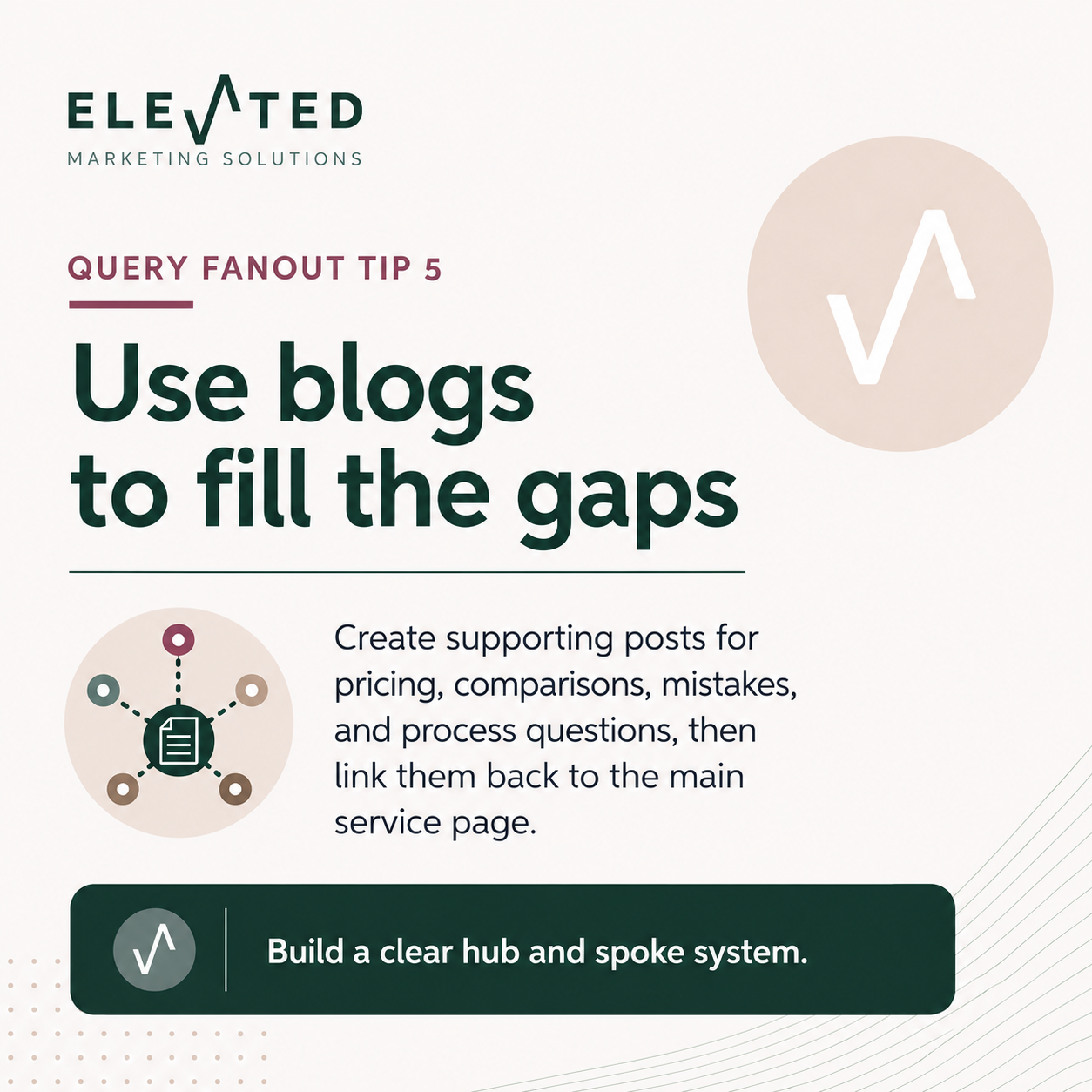
Blogs win when they fill the fanout gaps your service page shouldn’t carry in full.
The approach that keeps you sane: pick your core services, map the supporting questions buyers actually ask, then publish the “spoke answers” that complete the set. Not thought leadership for its own sake, answers.
Then link those spoke posts back to the relevant service page using plain-language anchor text that matches the question. You’re building a structure AI can follow: hub to spokes.
What to do if your content situation is messy, broad, thin, not answer-shaped, or unknown
If your content is messy, consolidate before you create. Merge overlapping posts, choose one “best answer” page per sub-question, and redirect the rest.
If your content is great but too broad, narrow it with decision-focused specificity: who it’s for, who it’s not, cost drivers, timeline, tradeoffs, common mistakes. Broad becomes cite-worthy when it gets concrete.
If your content is thin, start with one high-intent service and build depth around definition, process, cost, selection, and mistakes first. Thin sites lose because AI can’t find enough supporting coverage.
If your pages aren’t answer-shaped, rewrite headings into real questions a buyer would ask out loud, then answer each in 3 to 6 tight sentences before expanding.
If you don’t know what you have, ask: “If an AI had to answer five buyer questions about this service, could it do it from this page alone?” If not, those are your fanout gaps.
How to measure it, even when citations are hard to track
You’re right to call out the reality: citation tracking is messy.
Why? Because there isn’t a universal reporting layer that says “this click came from an AI citation” across every surface. Each platform has different UX, different link handling, and different attribution quirks. Even Google’s own guidance on AI features focuses more on eligibility and best practices than giving you a clean “AI Overviews performance” report. (Google for Developers)
Separate what’s measurable from what’s directional, then make decisions from the combination.
- Referral traffic: Watch referral sources and landing pages for movement after you optimize specific page clusters. This is the cleanest hard signal available, because it’s real sessions you can attribute.
- Page-level outcomes on fanout clusters: Choose a controlled set of pages you optimize (one service page plus its spokes), then track leads, calls, form submissions, and assisted conversions to that cluster over time.
- SERP spot checks for AI Overviews (directional, but trackable): Maintain a fixed set of queries and record whether you appear as a cited source. Manual, yes, but measurable.
- Search Console trends (supporting evidence): Watch query mix shifts, long-tail expansion, and performance changes on the pages you rewired for fanout. Treat this as supporting evidence, not perfect attribution. (Google for Developers)
- Behavior shifts when AI summaries show up: Use Pew’s finding as context for why your measurement needs to focus on clusters and outcomes, not just clicks. (Pew Research Center)
The win condition is not “prove every citation.” The win condition is “build content clusters that get surfaced more often, and produce measurable business lift.”
Your next content strategy move
If you want to optimize for query fanout without turning your content plan into chaos:
- Choose one service you care about most.
- List the top supporting questions from the fanout patterns above.
- Update the service page so the big answers show up near the top, clearly.
- Write the supporting blog posts that fill the remaining gaps, then link them like you mean it.
You’re not writing for the model, you’re writing for the buyer, and you’re structuring it so the model can’t ignore you.
If you take anything from this, let it be this: query fanout is not a new gimmick, it’s a new way your buyers are getting answers. Your job is still the same as it’s always been, earn trust by being genuinely helpful, clear, and specific. The adjustment is how you package that help. Build pages that answer the supporting questions your prospects actually ask, put the best answers where they’re easy to find, and connect the dots with intentional internal linking. Do that consistently and you’ll show up more often in AI citations, you’ll earn more of the clicks that still happen, and you’ll be building content that holds up even as the next “new tactic” comes and goes.