The Paradoxes of Modern Marketing in the Age of AI

Marketing today is full of contradictions.
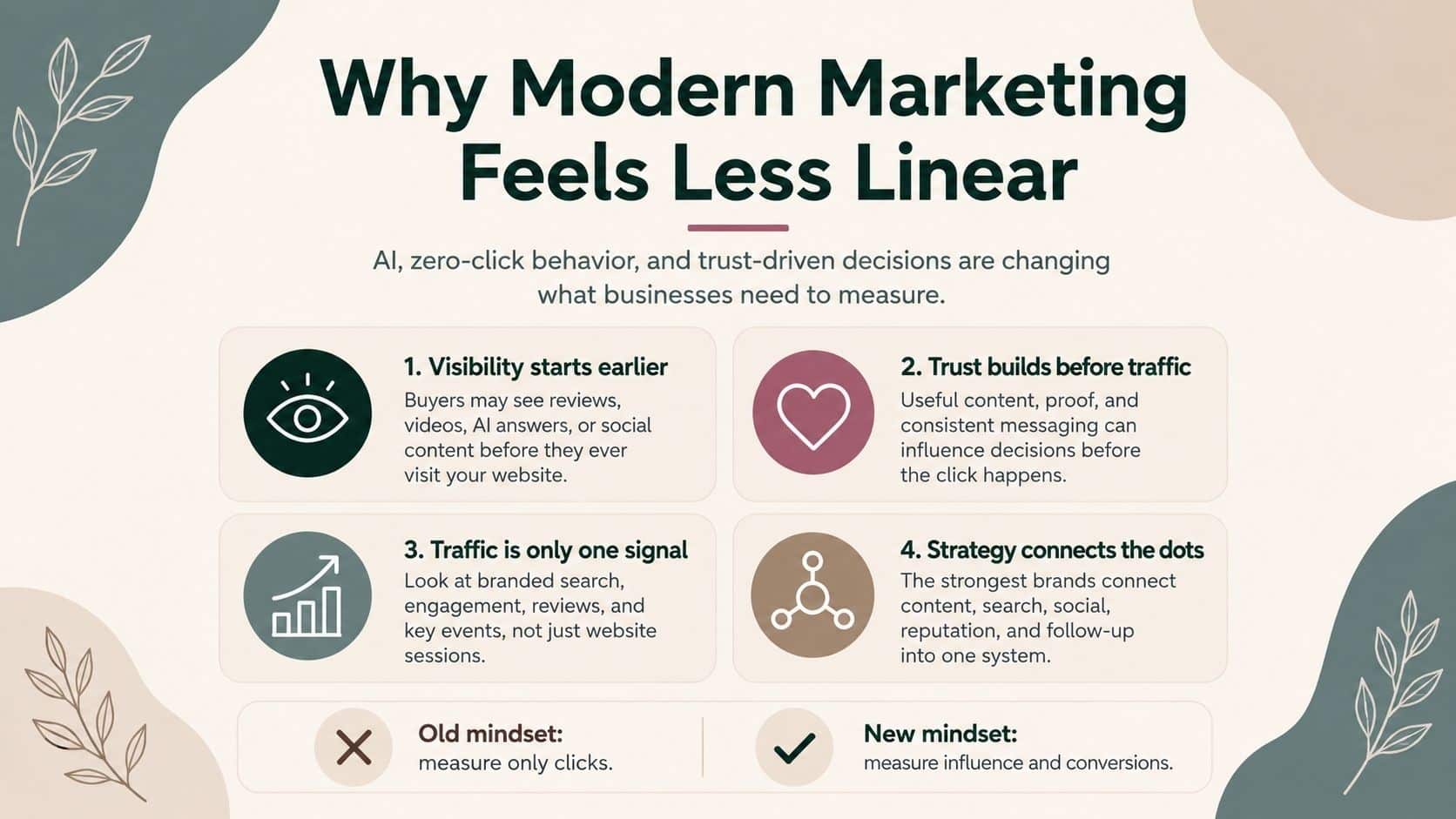
AI has made marketing faster, but not always clearer. We have more tools, but not always better understanding. We have more data, but not always a straight line to the answer. We have more ways to be visible, but the buyer journey is harder to follow than ever.
That is why modern marketing can feel confusing for business owners and marketing decision-makers.
Google AI Overviews, ChatGPT, social feeds, short-form video, retargeting, email, reviews, websites, paid ads, referrals, and offline conversations are all shaping decisions at the same time. A potential customer might see your name in a search result, read a review, watch a short video, see a social post, ask an AI tool a question, and only later visit your website.
For business owners, this can be frustrating because we naturally want marketing to be simple and linear.
Do this, get that.
Post here, get leads.
Run ads, get customers.
Rank on Google, get sales.
But marketing does not work that way because people do not make decisions that way.
The human mind is not linear. Buyers do not always move neatly from awareness to consideration to decision. They may hear about your business from a friend, forget about you for a while, see a review, watch a video, search your name, compare you to someone else, ask an AI tool a question, visit your website, leave, come back later, and only then reach out.
That is why marketing paradoxes exist.
A paradox is when two things seem opposite, but both are true. In marketing, these paradoxes exist because business decisions, human behavior, technology, trust, and measurement do not always fit into a clean formula.
And in the age of AI, these paradoxes are becoming even more obvious.
1. AI Makes Marketing Faster, But Strategy Matters More
AI can absolutely create efficiency.
It can help write content, summarize research, generate ideas, organize information, analyze data, build outlines, and speed up execution. For business owners,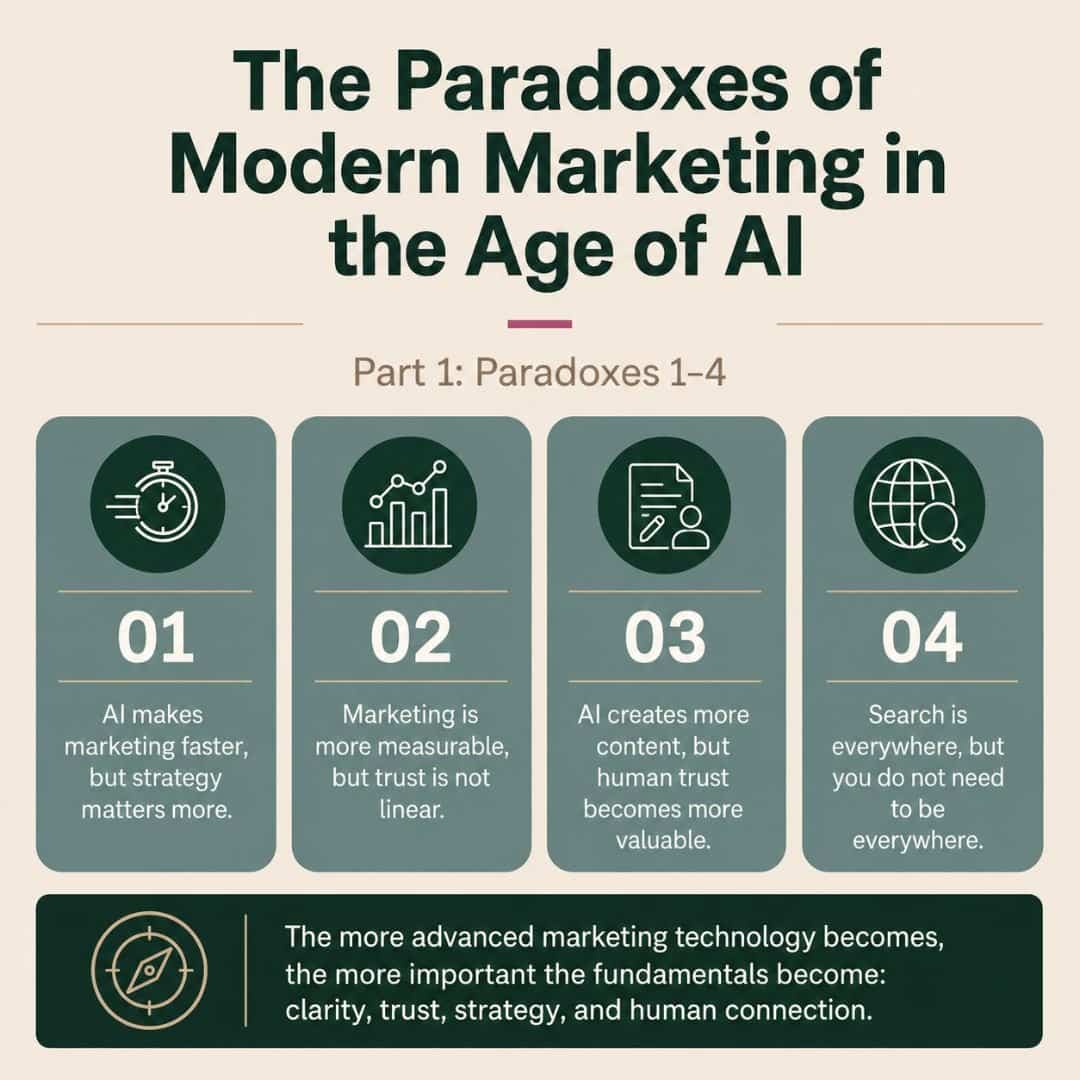 that promise is very attractive because every business owner wants to save time and money.
That is exactly why so many AI platforms and tools market themselves around speed, savings, and efficiency.
But there is a hidden paradox here.
AI creates efficiency, but it can also create new inefficiency.
The time savings are real in some areas, but they are not free. Businesses and marketers also spend time learning new tools, testing new workflows, evaluating output, correcting mistakes, rewriting generic content, adjusting to platform changes, and deciding whether the “faster” way is actually the better way.
There is a time swap happening that does not always get acknowledged.
You may spend less time producing something, but more time figuring out which tool to use, how to use it well, whether the result is accurate, and whether the output is strong enough to represent your business.
That is why speed alone is not the goal.
A blog post can be written quickly. A social post can be generated quickly. An email can be drafted quickly. An ad can be created quickly.
But marketing is not just about checking the box.
Marketing has to influence a buying decision.
Fast output is not valuable if it does not build trust, answer the right question, create clarity, reduce hesitation, or move the right person closer to action.
That is especially true for service-based businesses, healthcare, professional services, home services, B2B companies, and any business where the buyer has to compare options, evaluate trust, and feel confident before making a decision.
Something can be fast and inexpensive, but that does not mean it is good enough to influence the sale.
So the real advantage is not simply using AI to create more.
The advantage is knowing what should be created, why it matters, who it is for, and how it supports the buyer journey.
AI should support the strategy. It should not become the strategy.
2. Marketing Is More Measurable, But Trust Is Not Linear
Business owners and marketing decision-makers often struggle with this paradox the most.
We want a clear line from marketing activity to revenue.
We want to know which post, ad, blog, email, video, search result, or review caused someone to call, fill out a form, book an appointment, or make a purchase.
And sometimes, we can see that clearly.
But often, we cannot.
The goal of marketing has always been to create trust. That was true long before digital marketing existed. What changed is that digital platforms trained us to expect everything to be clickable, trackable, and directly attributable.
For a while, that made marketing feel more linear than it really was.
Now, zero-click search, AI-generated answers, social platforms, and changing user behavior are forcing us to remember something that has always been true:
Not every effective marketing touchpoint creates an immediate click.
A 2024 SparkToro study found that for every 1,000 Google searches in the United States, only 360 clicks went to the open web. That means a large amount of search behavior happens without a traditional website visit, even though the search itself may still influence what a person thinks, trusts, remembers, or does next. Source: SparkToro 2024 Zero-Click Search Study.
Before websites, analytics, and digital ads, businesses used billboards, TV, radio, direct mail, magazine ads, sponsorships, signage, events, referrals, community involvement, and word of mouth. None of those created a neat click path, but they absolutely influenced buying decisions.
So while “zero-click search” may sound like a new marketing term, the concept is not entirely new.
In many ways, it is old marketing making a comeback in a modern environment.
People have always been influenced before they take action. The difference now is that the influence may happen inside Google, ChatGPT, Instagram, TikTok, YouTube, Reddit, Facebook groups, review platforms, or AI-generated answers without an immediate visit to your website.
Platforms also have an incentive to keep people on their platforms. Search engines, social media platforms, and AI tools do not always want users to click away. Their goal is often to answer the question, hold attention, and keep the user engaged inside their environment.
That makes marketing harder to measure.
But it does not make the influence less real.
There is an old idea that applies well here:
It is not the last beer that gets you drunk. It is all the beers.
Marketing works the same way.
The last click may get the credit, but it is rarely the only thing that created the decision. A buyer may have been influenced by your reviews, social media posts, search visibility, email marketing, videos, referrals, ads, local reputation, direct mail, Google Business Profile, AI-generated mentions, or previous brand familiarity before they finally converted. That is why the goal is not to measure every single touchpoint perfectly. The goal is to look for trends and understand whether your marketing is moving in the right direction.
- Are website conversions/key events increasing? (Are calls, form fills, appointment requests, quote requests, purchases, or other key events improving over the last three months?)
- Are more qualified people reaching out?
- Are branded searches increasing?
- Are more people engaging with your content?
- Are reviews improving?
Those are the actions that hand the lead from marketing to the next part of the business. That might be sales, customer service, scheduling, the front office, an office manager, or an internal follow-up process.
All other marketing metrics help us understand what may be influencing those conversions. Search visibility, impressions, engagement, website traffic, social reach, email clicks, Google Business Profile actions, reviews, and branded searches all matter because they help us evaluate whether trust and demand are building. But marketing’s ultimate goal is to create more of the right key events and conversions.
Then the business has to look at what happens next.
- How quickly does someone follow up?
- How well is the call handled?
- Is the lead qualified?
- Does the sales process build trust?
- Does the office or customer service team move the person forward?
- Does the business close the opportunity?
- Does the customer experience lead to retention or referrals?
Marketing can create the opportunity, but revenue also depends on what happens after the conversion. That is why measurement cannot stop at the click.
3. AI Creates More Content, But Human Trust Becomes More Valuable
AI has made it easier than ever to create content.
That creates another paradox.
The more content AI helps produce, the more valuable real human trust becomes. People are craving humans. They want to know who they are buying from. They want to feel informed, not coerced. They want to feel like they are making a confident decision, not being pushed into a funnel. This is especially important because many people have mixed feelings about AI.
AI is helpful. It can be useful, efficient, creative, and powerful. But people also have concerns about whether AI-generated content is accurate, honest, original, or deceptive. Pew Research Center has found that Americans continue to be wary of AI’s impact on daily life. In a 2026 summary of recent surveys, Pew reported that half of U.S. adults say the increased use of AI in daily life makes them feel more concerned than excited, while only 10% say they feel more excited than concerned. Source: Pew Research Center, Key findings about how Americans view artificial intelligence.
That does not mean businesses should avoid AI.
The problem is not AI itself.
The problem is deception.
AI becomes a trust issue when people feel like it is being used to trick them, impersonate someone, fake expertise, manufacture credibility, manipulate emotion, or make something seem more human than it really is. Like anything else, there will be good uses and bad uses. Some businesses will use AI to communicate more clearly, educate customers, answer questions, and improve the customer experience. Others will use it to flood the internet with low-value content, create fake authority, mislead buyers, or make their business look more experienced or trustworthy than it actually is.
That is what businesses need to be careful about. In the race to create efficiency, businesses cannot lose credibility. This is where trustworthy businesses need to lean even harder into proof.
- Real photos matter.
- Real team members matter.
- Real customer stories matter.
- Testimonials and reviews matter.
- Case studies matter.
- Before-and-after examples matter.
- Specific service explanations matter.
- Clear points of view matter.
- Founder-led and expert-led content matters.
- Video content that shows personality and expertise matters.
AI can help shape the message, but the business still has to provide the truth behind the message.
This is also where marketing becomes harder, not easier.
It is not enough to publish more content. Businesses need to pull out the real stories, experiences, proof points, customer questions, differentiators, and trust signals that make the content meaningful. That requires deeper work. It requires understanding the business, listening to customers, asking better questions, identifying what makes the company credible, and turning that into marketing that feels honest and useful.
AI can support that process. But it cannot replace the real human experience behind the brand. The more AI-generated content people see, the more real human experience will stand out.
4. Search Is Everywhere, But That Does Not Mean You Need to Be Everywhere
Search is no longer limited to Google. People search on Google, YouTube, TikTok, Instagram, Reddit, Facebook groups, LinkedIn, Amazon, review platforms, ChatGPT, Google AI Overviews, Gemini, Perplexity, and many other places.
But this creates an important paradox. Search happens everywhere, but your business does not need to be everywhere. The goal is not to chase every platform, every trend, or every possible search environment. The goal is to understand where your specific audience looks for answers, validation, comparison, proof, and next steps.
- A homeowner looking for a roofer may search differently than a parent looking for a school.
- A patient looking for a specialist may search differently than a business owner looking for IT support.
- A bride looking for a venue may search differently than a manufacturer looking for a vendor.
Some buyers start with Google.
Some go straight to YouTube.
Some ask friends.
Some search social media.
Some rely heavily on reviews.
Some ask AI tools.
Some compare websites.
Some want case studies, credentials, pricing, examples, photos, testimonials, or educational content before they trust the business.
So the question is not:
Are we everywhere?
The better question is:
Are we showing up in the places that matter most to our buyer’s decision? That requires strategy.
A business needs to understand:
- Where the audience searches
- What questions they ask
- What doubts they have
- What proof they need
- What platform they trust for that type of decision
- What content format fits that moment
- How that platform connects back to the website, sales process, or conversion point
This is where broader search visibility matters, but it should not become a generic checklist.
- Website SEO may matter.
- Google Business Profile may matter.
- Reviews may matter.
- Blog content may matter.
- YouTube may matter.
- Social content may matter.
- AI-friendly content may matter.
- PR and brand mentions may matter.
- Paid ads may matter.
But the right mix depends on the audience, offer, location, budget, buyer journey, and business goal. Search visibility is not one channel.
It is an ecosystem.
SEO, AEO, social content, reviews, website content, paid ads, PR, email, local visibility, and offline reputation should not operate independently. They should work together to answer the buyer’s questions, build trust, and move the right person toward action.
Search is broader now, but strategy keeps it from becoming scattered.
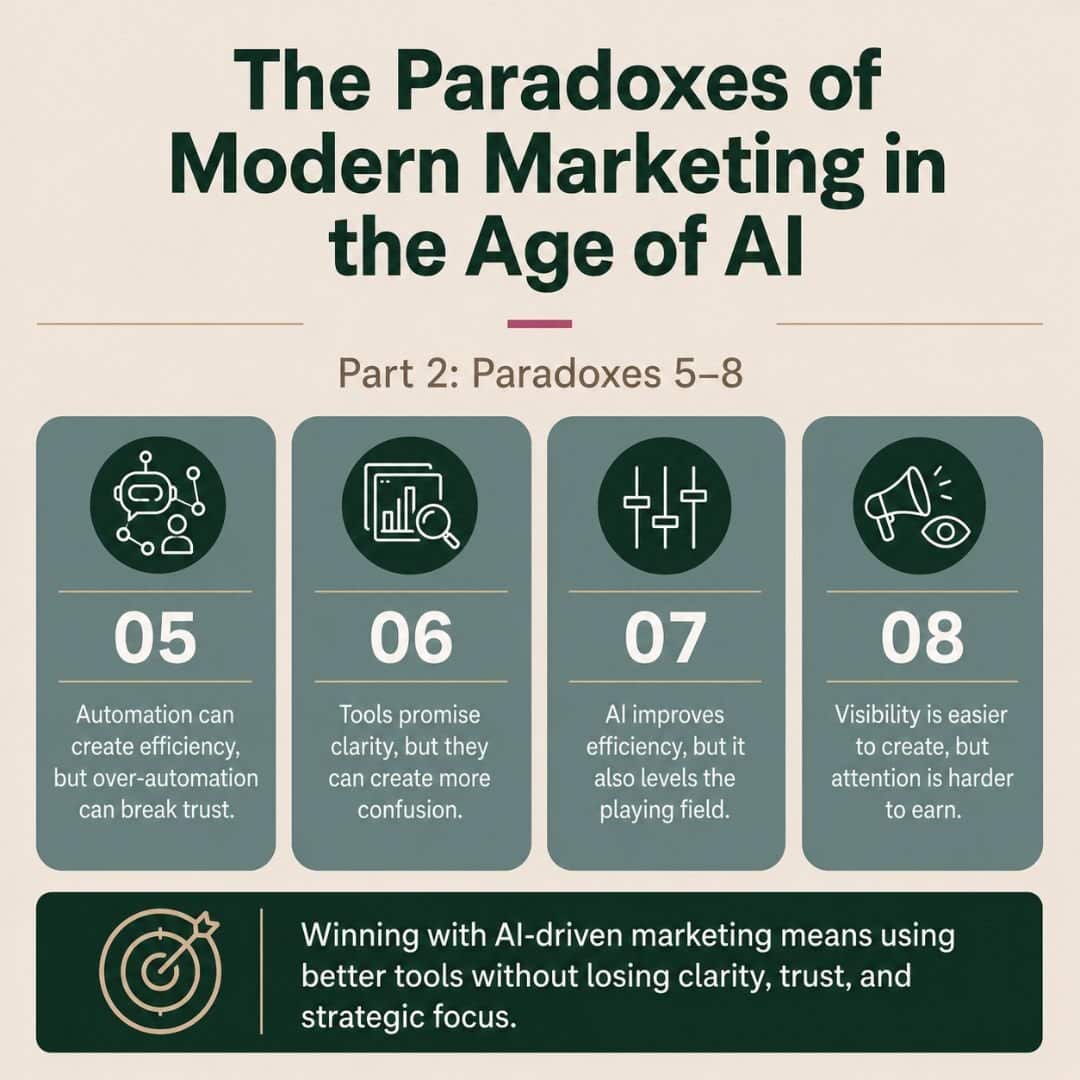
5. Automation Can Create Efficiency, But Over-Automation Can Break Trust
AI and automation are often marketed as ways to save time, reduce labor, speed up follow-up, and make the customer journey more efficient.
And automation can be extremely helpful.
 It can support appointment reminders, confirmation emails, review requests, basic follow-up sequences, lead routing, download delivery, abandoned cart reminders, internal task notifications, and educational email nurture.
But there is a limit.
When people feel like they are being automated, a trust barrier can break.
That is the paradox.
Automation can improve the experience, but over-automation can make people feel unseen, unheard, and unimportant.
When you automate, you are making assumptions about your audience. You are assuming they are in the same mindset, at the same stage, with the same question, needing the same next step.
But people are not that simple. Decisions are not that simple when it comes to buying products and services.
Buyers arrive with different concerns, emotions, urgency levels, frustrations, objections, and questions. Some people need a quick answer. Some need reassurance. Some need education. Some need empathy. Some need a human to help them sort through a situation that does not fit neatly into a prebuilt path.
Customer service is one of the clearest examples.
Many businesses have tried to automate customer service with chatbots, call trees, AI assistants, and self-service systems. Sometimes that works well for simple questions. But when someone has a specific issue, a billing concern, a complaint, a medical question, a service problem, or an urgent need, automation can quickly become frustrating.
- No one likes feeling trapped in a call tree when they already know what they need.
- No one likes typing a specific question into a chatbot that does not understand the problem.
- No one likes feeling like they are talking to a robot when what they really need is a human who can listen, empathize, and help.
Customer service is not just an operational function. It is a trust-building moment. When someone has a problem or a question, they often want empathy first and efficiency second. So the question should not only be: Can we automate this? The better question is: Should this moment feel automated?
Businesses need to map the customer journey and decide where automation helps and where it hurts.
- Where does automation make the experience easier?
- Where does it make the experience colder?
- Where does a person need reassurance?
- Where does someone need empathy?
- Where does the question become too specific for a generic response?
- Where should automation hand off to a human quickly?
Personalization is valuable. Automation is useful. AI can improve response times and consistency. But automation should not replace human judgment where trust is being built or repaired.
6. Marketing Tools Promise Clarity, But They Can Create More Confusion
There are more marketing tools than ever.
AI tools, automation platforms, CRMs, email systems, ad platforms, analytics dashboards, scheduling tools, call tracking, heat maps, reporting platforms, AI visibility tools, attribution software, and countless other systems all promise to help businesses understand what is working.
And we should want better data.
Marketing should be measured. Businesses should track what can be tracked. Data should inform decisions. A good marketing strategy should not be built on guesses alone.
But there is another paradox here.
The more tools we have, the more confusing the picture can become. Many software companies are now making big claims around tracking, attribution, AI visibility, buyer behavior, content performance, and marketing influence because they know business owners want certainty.
They know marketers want clearer answers.
They know everyone wants to feel better about whether marketing is working. But some of these tools are only measuring a narrow slice of the buyer journey. Some are estimating. Some are modeling. Some are using simulated situations that may not reflect your actual buyers, your actual market, or your actual sales process. Some tools are trying to solve the same messy attribution problem the rest of the industry is trying to solve while also selling a product that promises confidence.
That does not mean the tools are useless. It means we have to be honest about what they can and cannot tell us. Most tools tell you what is happening inside that tool. They do not automatically tell you what is happening across the entire marketing system. Google Analytics can show website behavior. Google Search Console can show organic search visibility. Ad platforms can show platform-reported results. Email platforms can show email engagement. Social platforms can show reach and engagement. Call tracking can show phone leads. CRM data can show sales movement. AI visibility tools may show partial visibility, estimated presence, or modeled results.
But no single tool gives the full strategic analysis.
That is why modern marketing requires triangulated data analysis. You have to compare multiple imperfect signals, look for patterns, evaluate trends, understand context, and connect the data back to what the business is trying to accomplish. That takes judgment. It requires someone who understands marketing strategy, buyer behavior, channel roles, attribution limits, sales process, customer experience, website conversion, lead quality, messaging, market context, and business goals. There is not one perfect tool that explains all of marketing. The goal is to use multiple imperfect signals to get closer to the truth. That is why reporting should not simply be a dashboard export.
A good marketing review should help answer:
- What happened?
- What changed?
- What does the data suggest?
- Where are we seeing momentum?
- Where are we seeing friction?
- What do we still not know?
- What should we do next?
That is the difference between having data and understanding what the data means.
7. AI Can Improve Efficiency, But It Levels the Playing Field
AI creates efficiency. But it creates efficiency for everyone. That means efficiency alone is not a long-term competitive advantage.
If every business can create content faster, research faster, write faster, analyze faster, and build campaigns faster, then speed becomes the new baseline. This creates a race where everyone is trying to become more efficient at the same time. If you learn quickly, you may have a short-term advantage. But eventually, other businesses and competitors will catch up. The tools will become easier to use. The knowledge will become more common. The efficiencies will become expected.
That means the real advantage is not simply using AI. The real advantage is using AI better.
That comes from stronger positioning, better customer understanding, better messaging, better creative judgment, better follow-up, stronger sales alignment, clearer reporting, better service, and a more connected marketing system.
AI should free up time for higher-value work.
That includes:
Better strategy
Better customer interviews
Better sales alignment
Better creative concepts
Better website conversion
Better reporting insights
Better content based on real expertise
Better follow-up
Better customer experience
AI should give marketers and business owners more room to think, not just more ways to produce.
8. Visibility Is Easier to Create, But Attention Is Harder to Earn
Anyone can publish now. That means the internet is full of content, ads, posts, emails, videos, podcasts, webinars, AI-generated answers, social updates, and automated messages. Visibility is easier. Attention is harder.
People spend a significant amount of time online and on social platforms, but that does not mean they are paying attention to every business that shows up in their feed. DataReportal’s Digital 2025 report found that there were 253 million active social media user identities in the United States in January 2025. Source: DataReportal Digital 2025: The United States of America. DataReportal’s global reporting also found that adult internet users spend an average of 6 hours and 38 minutes online each day. Source: DataReportal Digital 2025: Global Overview Report.
That means your business is not only competing with direct competitors. You are competing with everything else your audience sees in a day.
- Friends.
- Family.
- News.
- Entertainment.
- Influencers.
- Emails.
- Text messages.
- Work.
- AI answers.
- Videos.
- Ads.
- Search results.
- Reviews.
- Notifications.
That is why generic marketing is easier to ignore. Messages like “quality service,” “trusted experts,” “family-owned,” or “full-service solutions” are not always wrong, but they are often too vague to earn attention. Attention is earned through relevance, clarity, timing, specificity, and trust.
Instead of saying: We provide quality service. A stronger message might be: We help homeowners understand whether they need a repair or replacement before they waste money. Instead of saying: We are a full-service marketing agency. A stronger message might be: We help businesses stop wasting money on disconnected marketing so every dollar has a clear purpose.
The difference is clarity.
People pay attention when they quickly understand:
Who this is for
What problem it solves
Why it matters
Why they should trust it
What they should do next
In a crowded marketing environment, vague content disappears.
Specific, useful, trust-building content has a better chance of being remembered.
Strategic Takeaway
The biggest paradox of AI-driven marketing is this: The more advanced marketing technology becomes, the more important the fundamentals become. AI does not remove the need for positioning, messaging, trust, customer understanding, website clarity, content strategy, follow-up, reporting, and human judgment. It makes those things more important. Businesses do not need more disconnected output. They need a clearer marketing system.
- A system that understands where buyers search.
- A system that builds trust before the click.
- A system that uses AI without becoming deceptive.
- A system that automates the right moments without removing humanity from the moments that matter.
- A system that measures key events and conversions first, then works backward to understand what is influencing them.
- A system that uses multiple data sources to find patterns instead of relying on one tool to explain everything.
- A system that connects marketing to sales, customer service, retention, referrals, and revenue.
The businesses that win will not be the ones that simply use the most AI. They will be the ones that use AI to strengthen strategy, improve clarity, support better decisions, and create more meaningful human connection. Modern marketing is not about choosing between AI and human strategy. It is about using AI to make human strategy stronger.
That means businesses need to:
Create content that is useful, not just frequent.
Build visibility where their audience is actually looking.
Measure influence through trends, not just last clicks.
Prioritize key events and conversions.
Show proof, not just promises.
Use automation carefully.
Evaluate data from multiple sources.
Connect marketing to the full customer journey.
Remember that trust is still the goal.
Marketing has always been about influence. AI has changed the tools, the speed, and the platforms. But it has not changed the human being on the other side of the decision.