What is the Real Value of a Marketing Agency?

If you’re questioning whether a marketing agency is worth the investment, you’re not alone. Most business owners and marketing leaders hit a point where the internal team is stretched thin, growth feels inconsistent, or marketing is getting done but it isn’t clearly tied to revenue.
This post breaks down what a good agency actually provides, beyond deliverables. It’s about how strategy, execution, tools, and accountability come together to create momentum, and what that looks like when you’re trying to grow a service business without burning out your team or guessing your way through the next quarter.
1. Strategic clarity that actually moves revenue
A good agency doesn’t start with tactics, it starts with clarity. What are you selling, to whom, why should they pick you, and what has to happen between first touch and a signed agreement. That’s the difference between “we’re doing marketing” and “we’re building a growth system.”
When strategy is real, it forces prioritization. You stop spreading effort across twelve half-built channels and start making intentional tradeoffs based on where your buyers actually come from, what they need to believe, and how your sales process works. The value is focus, and focus is what turns marketing from a cost center into a lever.
2. Capacity and speed, without payroll bloat
This is the one most teams feel in their bones. You do not just need ideas, you need hands, momentum, and the ability to move without turning every initiative into a six-week internal project plan.
An agency gives you immediate lift, and it gives you elasticity. You can ramp up for a launch, a seasonal push, a hiring surge, or a new market, then dial back without carrying permanent headcount. The point is not “outsourcing,” the point is keeping your internal team out of the weeds so they can lead decisions, manage stakeholders, and protect the brand, instead of spending their best hours formatting landing pages and chasing deliverables.
3. Access to tools and technology you do not want to manage
Most companies do not lose because they picked the wrong tool. They lose because the tool stack becomes a half-configured, half-used mess that nobody owns, nobody trusts, and everybody complains about when reporting time comes around.
Agencies already have the infrastructure and the reps. Automation, attribution, analytics, creative workflow, reporting, testing, you get leverage without the months of setup and the ongoing babysitting. The value is not the subscription, it’s the implementation and the discipline that turns software into useful decisions.
4. Consistency in execution and ongoing optimization
Marketing rarely fails because of one bad idea. It fails because execution is inconsistent, priorities shift weekly, and nothing stays live long enough to learn from.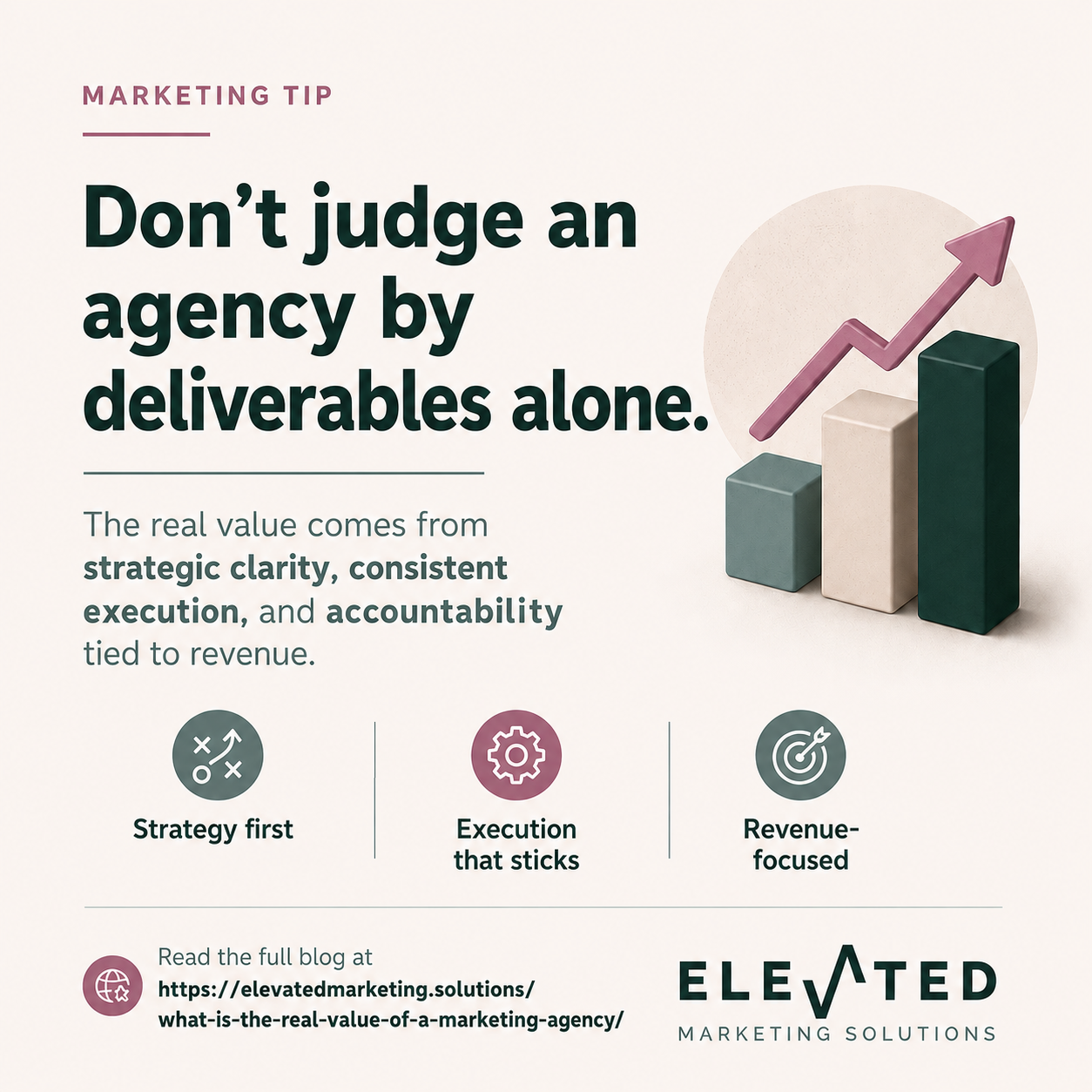 The best plan in the world cannot outperform chaotic operations.
A solid agency brings a cadence that keeps things moving: campaign calendars, weekly check-ins, performance reviews, and a workflow that makes “we should do this” turn into “this is live.” Then they optimize like adults, not like gamblers. They learn, adjust, improve creative, fix leaks in the funnel, and keep compounding gains instead of starting over every month.
5. Perspective you cannot get from the inside
When you are inside the business, you normalize things that are confusing to a buyer. You also protect assumptions because they feel familiar, even when the market has moved on. That is not a character flaw, it is just how being close to the work goes.
An agency earns its keep by seeing what you cannot see. They can say, “This offer is muddy,” or “Your best differentiator is buried,” or “Your website is talking like you, not like your customer.” They also bring pattern recognition from other industries and campaigns, which helps you avoid expensive detours and spot opportunities earlier.
6. Integrated, cross-channel marketing that actually works together
Most businesses are not short on marketing activity. They are short on alignment. Paid search says one thing, the website says another, email feels like a different company, and sales has their own deck that marketing never sees. Buyers feel that mismatch, and it lowers trust fast.
A good agency makes your channels act like one system. Messaging, creative, offers, and follow-up all reinforce each other, so your marketing feels consistent and intentional. That is when your spend starts working harder, because each touchpoint is helping the next one instead of resetting the conversation.
7. Innovative thinking from a team that has seen the patterns
“Innovation” can mean chasing shiny objects, and nobody needs that. What you actually want is a team that tests thoughtfully and brings ideas that are informed by what has already worked, what has failed, and what is changing right now.
Agencies sit in the arena every day. They see creative fatigue, platform shifts, changing buyer behavior, and what happens when a new channel looks exciting but does not convert. Done right, innovation is not novelty, it is controlled experimentation that creates upside without gambling your quarter.
8. The speed of change, and the advantage of staying ahead
Marketing is not stable. Algorithms change, ad platforms adjust targeting and bidding, privacy rules evolve, and AI is rewriting how content gets produced and discovered. Even strong internal teams struggle to keep up when marketing is only one piece of their job.
An agency keeps you from reacting six months late. They are monitoring changes, testing responses, and building learning loops across multiple accounts, so you benefit from broader performance data than your business can generate alone. The value is not trend awareness, it’s being early enough to protect performance and capture opportunities before your competitors do.
You need a partner, not a vendor
The real value of a marketing agency is not a list of tasks. It’s the edge you get when strategy, execution, systems, and accountability are all tied to actual business outcomes, and somebody wakes up every day thinking about how to make your marketing work better.
If your marketing feels disjointed, stagnant, or like it is draining more time than it should, your next move is not “try harder.” Your next move is to build a system, with clear priorities and consistent execution. You can do pieces of that in-house, but if you want speed, leverage, and a team that can run alongside you, that is where the right agency earns its fee.