Why isn’t our social media bringing in patients?

If you’re asking, “Why isn’t our social media bringing in patients?” you’re probably not asking because you hate marketing. You’re asking because you’ve been doing the work. You’ve been posting. Somebody on the team is trying to keep it consistent between patients and real life, and when you look at the schedule, nothing feels different. That gap, between effort and patient growth, is exactly where most practices get stuck.
And before you assume you need to post more, buy better equipment, or hire a full-time marketer, there’s a simpler explanation we see over and over: the content mix is off. Not the quality, not the frequency, the mix. You’re posting consistently, but patient growth is flat, here’s the fix that doesn’t require posting more.
We’ve helped healthcare practices get out of the random-posting loop, and this post is the playbook: the content mix that builds trust first, then earns the next step, engagement.
Why this matters when you’re already “doing social”
Most practice owners don’t wake up excited to outsource marketing. The trigger is usually frustration.
You’ve been posting for months. You’re visible. You’ve put in the effort. And when you zoom out, the schedule does not look meaningfully different.
That’s when it starts to feel like, “Maybe social just doesn’t work for healthcare,” or, “Maybe we’re just not good at this.”
Neither is true. What’s usually true is this: the calendar is not built to help a patient make a decision.
What’s actually going on when social is handled by “whoever has time”
When social is a spare-time task, it becomes reactive by default. You post what you can, when you can.
That creates a feed that feels like a hodge podge. Not because your team is doing a bad job, but because nobody has a system to answer:
- What should we be posting most often?
- What’s the job of each post?
- How does this turn into patient growth?
In healthcare, people are not casually buying something. They’re deciding whether they feel safe, informed, understood, and confident enough to take the next step. Your content has to earn that.
The content mix that makes healthcare social actually work
This is the backbone. If you only fix one thing, fix the mix.
Below is your content mix, kept exactly as you provided it:
Healthcare content has to build trust first, because people are not just buying something. They are deciding whether they feel safe, informed, understood, and confident enough to take the next step.
A good monthly healthcare social media content calendar should look something like this: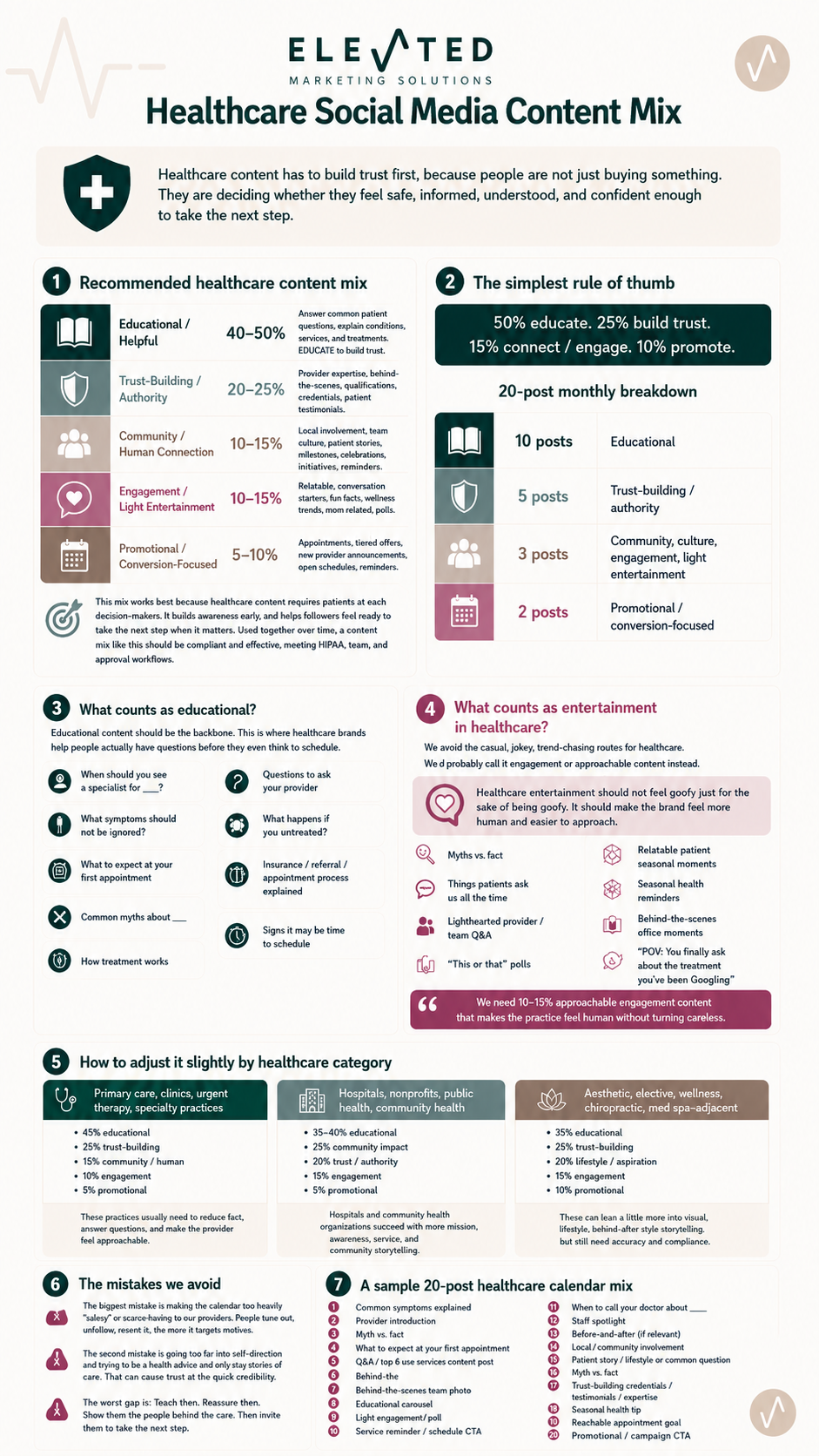
Content Type
Recommended
Educational / Helpful
40–50%
Answer common patient questions, reduce confusion, improve trust, support SEO/AEO topics
Trust-Building / Authority
20–25%
Provider expertise, behind-the-scenes, staff introductions, credentials, process explanations
Community / Human Connection
10–15%
Local involvement, team culture, patient-friendly moments, awareness days, mission-driven posts
Engagement / Light Entertainment
10–15%
Relatable, approachable, “myth vs. fact,” quizzes, trends used carefully
Promotional / Conversion-Focused
5–10%
Appointments, services, offers, new provider announcements, open scheduling, reminders
This lines up with the bigger healthcare content trend: patients are actively looking for reliable health answers online, and healthcare content needs to be accurate, patient-first, and trust-building rather than overly promotional. Healthcare social media also has added compliance concerns, so content should be careful with HIPAA, testimonials, medical claims, and approval workflows.
The simplest rule of thumb
For a full month, we reccomend;
50% educate. 25% build trust. 15% connect / engage. 10% promote.
That means if you are creating 20 posts in a month, the breakdown would be:
Monthly Posts
Content Type
- 10 posts
- Educational
- 5 posts
- Trust-building / authority
- 3 posts
- Community, culture, engagement, light entertainment
- 2 posts
- Promotional / conversion-focused
What counts as educational?
Educational content should be the backbone. This is where healthcare brands win because people usually have questions before they are ready to schedule.
Examples:
“When should you see a specialist for ___?”
“What symptoms should not be ignored?”
“What to expect at your first appointment”
“Common myths about ___”
“How treatment works”
“Questions to ask your provider”
“What happens if ___ goes untreated?”
“Insurance / referral / appointment process explained”
“Signs it may be time to schedule”
This type of content does more than fill the calendar. It supports search, builds confidence, and helps patients self-identify their need before they call.
What counts as approachable content in healthcare?
Approachable content in Healthcare could alos be called “entertainment content” to some. It should not feel goofy just for the sake of being goofy. It should make the brand feel more human and easier to approach.
Examples:
Myth vs. fact
“Things patients ask us all the time”
Lighthearted provider/team Q&A
“This or that” polls
Relatable patient journey moments
Seasonal health reminders
Behind-the-scenes office moments
“POV: You finally ask about the symptom you’ve been Googling”
So instead of saying, “We need 20% entertainment,” I’d say:
We need 10–15% approachable engagement content that makes the practice feel human without hurting credibility.
There are a lot of different healthcare categories, and they don’t all earn trust the same way, or for the same reasons. A primary care clinic is usually answering “Is this serious?” and “What happens if I come in?” while an elective or wellness practice is often dealing with comparison shopping, aesthetic concerns, and higher sensitivity around outcomes. Hospitals and community health organizations may need more mission, public education, and community storytelling than appointment-driven content.
That’s why a content mix should never be a rigid template.
The goal is to start with a proven baseline, then adjust the ratios based on what your patients need to feel confident, what your services require to explain clearly, and how people typically choose care in your category.
Primary care, dental, eye care, therapy, specialty practices
Use:
45% educational
25% trust-building
15% community / human
10% engagement
5% promotional
These practices usually need to reduce fear, answer questions, and make the provider feel approachable.
Hospitals, nonprofits, public health, community health
Use:
35–40% educational
25% community impact
20% trust / authority
10% engagement
5% promotional
Hospitals and community health organizations usually need more mission, awareness, recruitment, and community storytelling. Social media in healthcare is commonly used for patient education, public health awareness, community engagement, and organizational outreach.
Aesthetic, elective, wellness, chiropractic, med spa-adjacent
Use:
35% educational
20% trust-building
20% lifestyle / aspiration
15% engagement
10% promotional
These can lean a little more into visual, lifestyle, before/after-style storytelling, but still need accuracy and compliance.
The mistake we’d avoid
The biggest mistake is making the calendar too heavily:
“Here’s our service. Here’s our provider. Here’s our offer. Schedule today.”
That gets boring fast.
The second mistake is going too far the other direction and trying to make healthcare content overly trendy or funny. That can weaken trust if the topic is sensitive.
The sweet spot is:
Teach them. Reassure them. Show them the people behind the care. Then invite them to take the next step.
A sample 20-post healthcare calendar mix
Post 1: Common symptoms explained
Post 2: Provider introduction
Post 3: Myth vs. fact
Post 4: What to expect at your first appointment
Post 5: Community or awareness month post
Post 6: Patient FAQ
Post 7: Behind-the-scenes team photo
Post 8: Educational carousel
Post 9: Light engagement poll
Post 10: Service reminder / schedule CTA
Post 11: “When to call your doctor about ___”
Post 12: Staff spotlight
Post 13: Process explanation
Post 14: Local/community involvement
Post 15: Short video answering a common question
Post 16: Myth vs. fact
Post 17: Trust-building credentials / technology / approach
Post 18: Seasonal health tip
Post 19: Relatable engagement post
Post 20: Appointment or campaign CTA
For Elevated’s strategist guidelines, I’d probably document it as:
Healthcare social calendars should be roughly 50% educational, 25% trust-building, 15% human/engagement, and 10% promotional. Entertainment should be used carefully and should make the provider feel approachable, not unserious.
What usually goes wrong when the mix isn’t deliberate
If your mix is off, you can post a lot and still feel like nothing is happening. Usually it breaks in one of two directions.
One direction is too promotional. It becomes “schedule now” content with no runway. Patients aren’t ready yet, and you can feel that in the silence.
The other direction is too generic or too trendy. It might get a few likes, but it doesn’t build the kind of confidence that leads to a call, a form fill, or a booked appointment.
The mix is the correction. It keeps you from over-selling, and it keeps you from drifting into content that’s easy to post but hard to tie to growth.
The part about outsourcing that nobody says out loud
Typically what we hear is some version of this:
“I know we need help, but outsourcing our marketing is more than we’d like to spend, and it’s hard to tie the ROI to actual patient growth.”
That’s a fair concern. You’re not buying marketing to feel busy, you’re buying it to grow. If you’ve ever paid for social before and all you got was a steady stream of posts that didn’t change the schedule, it makes total sense to be skeptical.
Here’s the issue though, and it’s not your fault. Most healthcare practices don’t have a posting problem, they have a content strategy problem.
When the content mix is random, you can post consistently and still get inconsistent results. And that’s exactly what makes outsourcing feel expensive, because you’re paying for activity without being able to connect it to outcomes.
The content mix is what fixes that.
Once your calendar is built around the right ratio of educational, trust-building, community/connection, engagement, and only a small amount of promotion, two things happen:
- patients start getting the information they need to feel confident, not just reminded that you exist
- you finally have a system you can measure, because you know what each type of content is supposed to do
At that point, outsourcing stops being “pay someone to post,” and becomes, “pay someone to run a strategy that consistently earns trust and drives the next step.”
What to do next if you keep it in-house, and what to demand if you outsource
Here’s the cleanest next step you can take this week:
- Pull the last 30 days of posts.
- Label each post using the five categories in the mix.
- Compare your actual ratio to the recommended ratio.
If you’re light on educational and trust-building, you’ve found the bottleneck. If you’re heavy on promotional, you’ve found the resistance. If you’re heavy on community and engagement but light on clarity, you’ve found why people like you but don’t book.
If you outsource, ask for the thing most vendors skip: a documented mix, a monthly plan built around it, and a workflow that makes it easy for you to approve content without living in Slack.
What you’re probably wondering right now
Do I need to post more to get growth?
Not usually. Most practices need a better ratio, not more volume.
What if we don’t have time for educational content?
That’s exactly why you want the mix. It turns educational content into a repeatable category, not a weekly creative panic.
What if we’re worried about compliance?
You can build trust without sharing anything sensitive. Stick to general education, process clarity, expectations, and “what happens next” content, and build an approval habit that protects the practice.
If we outsource, how do we avoid paying for “activity” again?
Make the partner own the strategy, not just the posting. The mix is the strategy. If they can’t explain how they’ll manage it, they’re selling you content, not outcomes.
How long until we feel a difference?
You’ll usually feel it first in the conversations, better questions, more intent, more “this is exactly what I needed.” Patient growth follows when you keep the mix consistent long enough for trust to compound.
If you want to tighten this to your world, tell me what kind of practice you run and your top three services, and I’ll tailor the opening and examples so it reads like you wrote it, while keeping your content mix section exactly as-is.